Melting Ice, Frozen Power: What Norway’s 1,500-Year-Old Reindeer Trap Really Tells Us

Sarah Johnson
December 13, 2025
Brief
A 1,500-year-old reindeer hunting complex emerging from Norway’s melting ice reshapes our understanding of Iron Age economies, mountain power structures, and the uneasy role of climate change in revealing lost history.
Melting Ice, Frozen History: What a 1,500-Year-Old Reindeer Trap Reveals About Climate, Power, and Survival
At first glance, the discovery of a 1,500-year-old wooden reindeer hunting facility high in Norway’s mountains looks like a remarkable but niche archaeological story. In reality, it sits at the intersection of three of the biggest forces shaping our world today: climate change, the deep history of human environmental management, and the politics of Arctic and sub-Arctic resources.
The Aurlandsfjellet plateau find is not just a curiosity. It challenges what we think we know about early Iron Age Scandinavia, exposes how dependent archaeology has become on melting ice, and forces a difficult question: how much knowledge are we gaining precisely because we are losing the cryosphere that preserved it?
A wooden trap that rewrites assumptions about Iron Age Norway
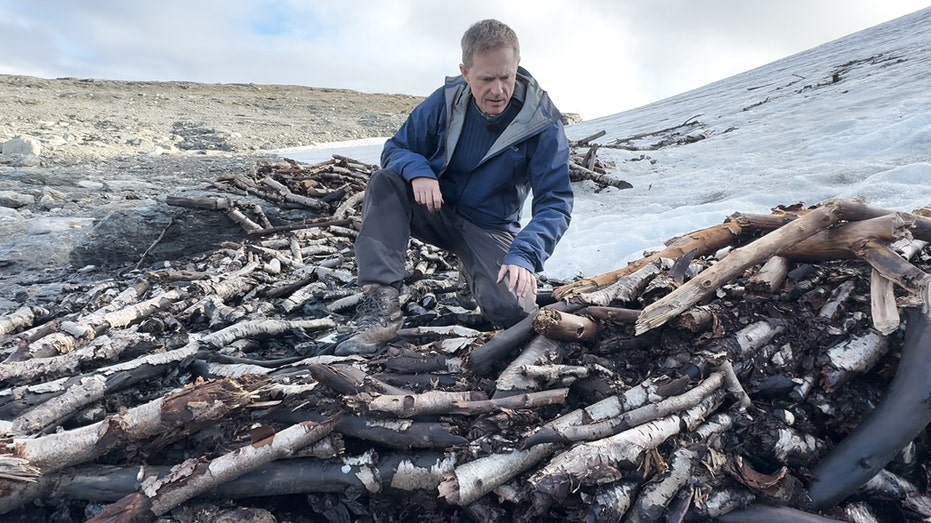
For years, archaeologists working in Norway’s mountains have documented stone-built hunting blinds, drive lines and pit systems used to trap reindeer. The Aurlandsfjellet site, built almost entirely of wood, upends that pattern.
According to the team from the University Museum of Bergen and Vestland County, the facility consisted of hundreds of hewn logs, long wooden fences guiding the animals into a narrowing funnel, and a sluice-like pen where reindeer were extracted one by one with spears. The funnel appears to have extended up to roughly 300 meters (about 1,000 feet) wide at its opening — a scale suggesting not opportunistic hunting but industrial-level organization.
Several details stand out:
- Complete reliance on wood: In a harsh alpine environment where wood is scarce and heavy to transport, this was a deliberate, resource-intensive choice. Thousands of logs, weighing several tons in total, had to be carried high into the mountains.
- Specialization of labor: The absence of bones but the presence of heaps of antlers shows this was not a campsite where animals were eaten on the spot. It was a specialized processing hub where carcasses were rapidly broken down and moved elsewhere, likely to lower-lying settlements or trading points.
- Evidence of value-added products: The antler pile — dominated by smaller antlers from females and younger animals — suggests selective removal. Large male antlers were probably taken away to be worked into combs, pins, and other high-value goods, hinting at an early form of bioeconomy around reindeer.
What emerges is a picture of a sophisticated hunting landscape, not random subsistence activity. This was planned, coordinated exploitation of a migratory resource on a scale that speaks to social organization, logistics, and long-term environmental knowledge.
The bigger picture: reindeer, power, and proto-economies in the Early Iron Age
The facility dates to the Early Iron Age, roughly 1,500 years ago — a period of profound transition in Scandinavia. Iron production was spreading, social hierarchies were sharpening, and long-distance trade networks were becoming more structured. Reindeer were central to this transformation in ways we’re only beginning to map.
Reindeer provided:
- Meat and fat for local consumption and for supporting larger households or warrior elites.
- Hides for clothing, shelter, and possibly for trade.
- Antler as a key raw material for tools, ornaments, and status objects.
In other words, reindeer were not just food; they were a package of commodities. This facility looks strikingly like a proto-industrial node in that package — designed to concentrate, process, and redistribute animal resources.
That has at least three implications:
- Concentrated control over mountain resources: A wooden structure of this scale implies ownership and authority. Not everyone could decide to build or use such a facility. The work of cutting, hauling, and assembling thousands of logs, plus coordinating hunts with weapons and manpower, strongly suggests leadership — whether in the form of household heads, local chieftains, or ritual authorities.
- A managed landscape, not a wilderness: We tend to imagine early Scandinavia as a sparsely populated wilderness dotted with farms and temporary camps. Finds like this show a networked landscape with seasonal infrastructure: mountain facilities, valley farms, waterborne trade routes and coastal hubs interlinked in a system of resource extraction and redistribution.
- Early sustainability questions: A facility capable of driving whole herds into a pen carries obvious risk of overexploitation. The absence of bones could indicate efficient removal of carcasses — or it could, in the long term, reflect the kind of intensive extraction that stresses wildlife populations, a pattern seen in later medieval mass-hunting systems elsewhere in Scandinavia.
A climate emergency is becoming a research tool — and a ticking clock
The reason this trap survived at all is the same reason it is now emerging: ice. For roughly 1,500 years, the high-altitude conditions at Aurlandsfjellet kept wooden structures, antlers, and organic artifacts frozen, protected from rot and insect damage. Only as glaciers and permanent snow patches retreat under modern warming do such sites appear.
Glacial archaeologists have been warning for over a decade that climate change is creating a tragic paradox:
- More discoveries: As ice melts, previously unknown artifacts — from hunting gear to clothing, skis, and even ancient routes — surface in large numbers across Norway, the Alps, and other mountain systems.
- Less time to save them: Once exposed, organic materials can degrade within a single season. Archaeologists must race to survey and collect before sunlight, rain, and microbial activity destroy the very evidence the melting revealed.
The Aurlandsfjellet discovery underscores how archaeology is being reshaped into a form of emergency response, akin to disaster relief — only the disaster is slow but relentless, driven by global emissions rather than a single event.
There is an uncomfortable ethical layer here. Our knowledge of the past is expanding because the cryosphere is collapsing. Each new breakthrough comes with a cost: we are documenting ancient adaptation strategies at the same time that modern societies struggle — sometimes unsuccessfully — to adapt to accelerated climate change.
What the artifacts say about identity, aesthetics, and daily life
Beyond the large-scale wooden structure, two finds highlight the complexity of the people behind this facility: a decorated pine oar and an axe-shaped antler clothing pin.
The oar, originally belonging to a rowboat located an estimated 1,400 meters lower in the landscape, raises perplexing questions. Why was a richly ornamented boating tool carried into a high-mountain hunting environment?
Two non-mutually exclusive interpretations emerge:
- Practical repurposing: As the archaeologists suggest, it may have been reused as part of the guiding barriers or structural supports. In societies where wood was precious, reusing a functional object at the end of its marine life would be rational.
- Symbolic or status significance: Its elaborate decoration hints at more than pure utility. Carrying such an item into the mountains could reflect ritual elements around hunting, or simply that status-marked objects circulated widely within the community, accompanying their owners into different seasonal spheres of life.
The antler clothing pin, described as so sharp it can still sting today, adds a micro-level window into aesthetics and identity. Axe-shaped and made of reindeer antler, it bridges two domains: hunting (its material) and warfare or craftsmanship (its form).
This convergence of materials and motifs is significant. It suggests that for these communities, the boundary between subsistence and symbolism was thin. Everyday objects carried visual references to power, skill, and perhaps myth — a pattern that later becomes prominent in Viking Age material culture but is clearly rooted deeper in time.
What’s missing may be as important as what was found
The conspicuous absence of bones or full skeletons, despite massive quantities of antlers, is not a trivial detail. It suggests:
- High-speed logistics: Animals likely were slaughtered and butchered quickly, with meat and hides transported down from the mountains before decay set in.
- Organized distribution networks: Moving “tons” of meat, as the archaeologists estimate, implies pack animals, sleds, or coordinated human porterage — all of which require social organization and planning.
- Selective on-site processing: Only what was bulky but of lower trade value (like most antlers) seems to have been discarded locally, while high-value materials and meat were removed. That’s a hallmark of an economy aware of weight, value, and distance — fundamental logistics thinking.
In modern terms, this site looks less like a camp and more like a remote processing plant: raw material (live reindeer) comes in, high-value product (meat, hides, selected antler) moves out, and low-value waste (most antlers) remains at the production site.
Why this matters beyond archaeology
For contemporary readers, this isn’t just about ancient Norwegians and their reindeer. The Aurlandsfjellet facility connects to several live debates:
- Indigenous and local resource rights: Although this site predates documented Sámi pastoralism in many areas, it feeds into broader questions about how northern landscapes were used, controlled, and contested — debates that today shape policy on reindeer herding, land rights, and development in Norway and across the Arctic.
- Climate risk to cultural heritage: UNESCO and national heritage agencies increasingly treat ice and permafrost melt as a direct threat to human history. Sites like this will pressure governments to allocate more funding for rapid-response archaeology or accept the loss of unrecoverable knowledge.
- Understanding long-term human–wildlife relationships: In a world grappling with biodiversity loss, evidence of large-scale prehistoric hunting can help calibrate our sense of what ecosystems looked like before industrialization — and how human pressure shapes animal populations over centuries.
Looking ahead: from single site to regional system
Archaeologists are clear that they have only begun to sample the Aurlandsfjellet material. As new scientific methods — from ancient DNA and isotope analysis to microbotanical studies — are applied, several lines of inquiry could transform our understanding:
- Reindeer population history: DNA from antlers could trace herd structure, genetic diversity, and possibly migration patterns over time, shedding light on how human exploitation impacted wild reindeer.
- Diet and origin: Isotopic analysis might reveal whether these reindeer fed in specific ecological zones, linking hunting intensity to particular pastures and climate conditions.
- Crafts and trade: Comparative analysis of the antler pin and other objects may tie this mountain site to coastal or inland workshops, illuminating trade routes connecting highland and lowland communities.
There is also a looming question: how many similar wooden facilities lie hidden under remaining snowfields and ice? If melting continues at current rates, we may see a rapid, one-time window of discoveries in the next few decades, followed by a permanent loss of organic evidence as the last ice disappears.
The bottom line
The Aurlandsfjellet reindeer hunting facility is not just a 1,500-year-old curiosity that still smells faintly of animal. It is a rare, high-resolution snapshot of a society that engineered its mountain landscape for large-scale resource extraction, blended practical logistics with artistic expression, and operated within a complex ecological system we are only now beginning to reconstruct.
Its emergence from melting ice is both a gift to science and a warning. We are learning more about how past societies adapted to challenging environments at the precise moment when our own adaptation to a rapidly changing climate is being tested. In that sense, this wooden trap is also a mirror, asking whether we are as skilled at balancing exploitation and sustainability as the people who built it — and whether we will leave future archaeologists anything as well preserved to study.
Topics
Editor's Comments
What’s most striking about the Aurlandsfjellet discovery isn’t the drama of a 1,500-year-old trap emerging from ice — it’s how quickly the story pivots from scientific triumph to systemic vulnerability. This is a textbook case of what we might call “salvage knowledge”: insights only available because something else is being irreversibly lost. The wooden fences and oar suggest a society capable of complex planning and infrastructure in a harsh environment, yet our ability to understand that sophistication depends on a 21st-century failure to control emissions. That tension rarely appears in mainstream coverage, which tends to celebrate the romance of ancient finds while downplaying the climate context that makes them visible. Going forward, one key question is whether governments will treat glacial archaeology as an emergency cultural-heritage issue — with dedicated funding and rapid-response protocols — or allow a patchwork, under-resourced approach to determine which pieces of the deep past survive this century. The Aurlandsfjellet trap may be a spectacular outlier, but it’s almost certainly also a harbinger of a much larger, largely unrecorded archaeological record now sitting on a melting fuse.
Like this article? Share it with your friends!
If you find this article interesting, feel free to share it with your friends!
Thank you for your support! Sharing is the greatest encouragement for us.