Beyond the Windy Field: What a 900-Year-Old Jesus Figurine Reveals About Norway’s Past and Our Future

Sarah Johnson
December 13, 2025
Brief
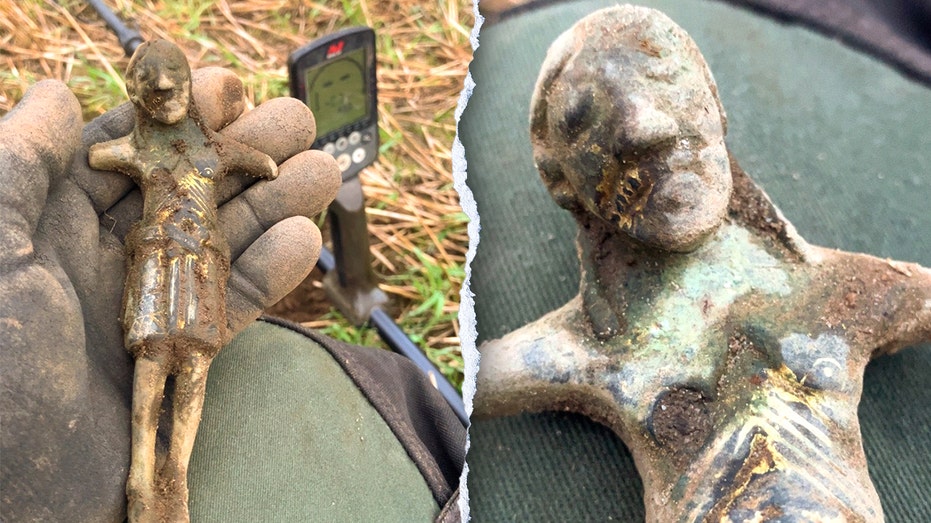
A 900-year-old gilded Jesus figurine found in a Norwegian field reveals far more than a lucky discovery—it illuminates Christianization, heritage laws, and the growing power of citizen archaeology.
What a 900-Year-Old Jesus Figurine in a Norwegian Field Really Tells Us About Europe’s Past – and Our Present
On its surface, the story is irresistible: a hobbyist metal detectorist battling fierce winds in coastal Norway looks down and locks eyes with a 900-year-old gilded figure of Jesus. But beneath the romantic narrative lies something more consequential – a rare, material snapshot of a Europe in transition, where Viking-age beliefs, emerging Christian power structures, and modern battles over cultural heritage all intersect in one tiny object pulled from the soil.
This figurine, likely from around 1100 A.D., is not just a devotional trinket. It is a data point in a much larger story: the Christianization of Scandinavia, the circulation of religious objects across medieval trade routes, the democratization of archaeology through citizen detectorists, and the modern debate over who owns the past.
A 12th-Century Europe in Miniature
To understand why this discovery matters, you have to place it squarely in its historical moment. Around 1100 A.D., Norway was undergoing profound religious and political transformation.
- Christianization was still relatively new. Norway’s formal conversion is usually dated to the 10th–11th centuries, with King Olaf II (St. Olaf) as a central figure. But formal conversion is not the same as deep cultural change. Archaeology shows that pre-Christian burial practices, symbols, and beliefs lingered for generations.
- Church organization was consolidating. The 1100s saw the increasing power of the Catholic Church in Scandinavia – church building, establishment of parishes, and tighter ties to Rome. A high-quality gilded figure of Christ fits squarely in this phase of expanding liturgical and visual culture.
- Trade and mobility were reshaping the region. Norway was plugged into North Sea and Baltic trade networks linking it to England, Germany, and beyond. Religious objects – crucifixes, reliquaries, pilgrim badges – circulated widely as both devotional and commercial items.
The figurine’s gilding and refined details suggest it wasn’t a crude local copy. It may have been imported or produced by a craftsman influenced by continental styles, possibly as part of a crucifix, a processional cross, or a liturgical object. Its presence in a windswept field near a hill where an old church once stood hints at a landscape that was once more densely populated with sacred objects than the quiet scene suggests today.
From Viking Axes to Crucifixes: A Religious Turn Written in Metal
Norway’s archaeological record over the last 150 years traces a slow but unmistakable shift: from weapon-rich pagan burials to ecclesiastical metalwork, church fittings, reliquaries, and Christian grave goods.
In this context, a 900-year-old figure of Jesus in a rural field is less an anomaly and more a missing piece of a pattern. It testifies to several overlapping transitions:
- Visual dominance of Christianity. The cross and the suffering body of Christ became the central public symbols of faith, replacing animal and mythic motifs of Norse religion. A gilded figure would have communicated not just belief, but institutional and economic power.
- Everyday encounters with sacred imagery. In the early Christian centuries, many Norwegians experienced the new religion first not via texts, but through images – crucifixes, altar pieces, and processional objects. This figurine may have been part of that visual catechism.
- Hybrid belief worlds. Archaeologists in Scandinavia repeatedly find Christian objects in contexts that also contain older symbols. That raises the possibility that such a figurine might have existed in a world where Christian and older cosmologies coexisted, overlapped, or quietly clashed.
What makes this find stand out is Dybvik’s remark that nothing like it has been found in this way in Norway before. That’s not hyperbole so much as a reflection of how skewed our archaeological record still is – heavily weighted toward burial contexts, church sites, or known settlements. A single object found in a field can redraw the map of where, and how intensively, Christianity was present in a region.
Why Objects Like This Keep Appearing Now – Not Then
The timing of the find – on All Saints’ Day – makes for good storytelling, especially for a deeply symbolic object. But the deeper reason this figurine surfaced in 2025 rather than 1925 is technological and regulatory, not mystical.
Several forces are converging:
- The rise of citizen detectorists. In countries like Norway, Denmark, and the U.K., thousands of hobbyists now sweep fields that professionals rarely visit. Many major finds in the last 20 years – from Viking hoards to Roman artifacts – have come from amateurs working under clear legal frameworks.
- Better equipment, better coverage. Modern detectors can distinguish subtle variations in metals and depth, increasing the likelihood that small, precious objects will be found before they are destroyed by plowing, erosion, or development.
- Stricter heritage laws. Norway’s rule that all objects predating 1537 must be reported is crucial. 1537 marks the Reformation and the end of Catholicism’s official dominance – and serves as a legal watershed for what counts as protected medieval heritage.
Without that regulatory backbone, the figurine might have ended up in a private collection or on an online marketplace, stripped of provenance and effectively lost to scholarship. Instead, it is now being conserved under the supervision of county archaeologists and will likely undergo scientific analysis: alloy composition, tool marks, and stylistic comparison with other known pieces.
The Quiet Power Struggle Over Who Owns the Past
This discovery also illuminates a subtler contest: who gets to interact with, interpret, and profit from the past.
Norway’s system represents a middle path between two extremes:
- Total prohibition on metal detecting and strict central control (common in parts of southern Europe), which can push activity underground.
- Light regulation and high private rewards (as in some U.K. scenarios), which encourage reporting but also create a market-driven view of heritage.
Here, the detectorist is neither outlaw nor sole owner; he is a participant in a shared stewardship model. The fact that Dybvik immediately contacted authorities, and speaks in terms of “cultural heritage” and collective identity, suggests that for many enthusiasts, the emotional reward of contributing to history outweighs the loss of personal ownership.
This model has global relevance. As climate change accelerates coastal erosion and exposes new archaeological layers, and as conflicts raise the value of looted antiquities, the question of how to harness citizen energy while protecting heritage is gaining urgency.
The Emotional Charge of Religious Objects
The language Dybvik uses – “he revealed himself to me,” “I looked Jesus straight in the eyes,” “a glimpse of divinity” – isn’t just colorful. It highlights a frequently underexamined aspect of religion and archaeology: the enduring emotional power of sacred imagery, even centuries detached from its original context.
For medieval worshippers, such a figure of Christ was not merely symbolic. In Catholic devotional culture, images of the crucified Christ often mediated a sense of presence, suffering, and intercession. The notion that an image could “look back” at you is not anachronistic; it is integral to how medieval Christians engaged with sacred art.
That a modern, secular hobbyist can have a quasi-spiritual experience upon unearthing the figure suggests that material religion retains a potency independent of formal belief. It also underscores why disputes over religious artifacts – from mosque mosaics to church relics – are often so charged: these are not simply “art objects” to the communities that claim them, but tangible bridges between past and present identities.
What Experts Will Be Asking Next
As conservators and archaeologists study the figurine, a series of technical and interpretive questions will shape its ultimate significance:
- Function: Was it part of a larger crucifix, a reliquary, a processional cross, or a personal devotional object, perhaps worn or carried?
- Origin: Do stylistic features and metal composition point to local manufacture, or to workshops in England, northern Germany, or the Low Countries?
- Context: Can the findspot be linked with documentary evidence of the vanished church on the nearby hill? Are there foundations, burials, or other artifacts in the vicinity?
- Loss or deliberate deposition: Was it accidentally lost, perhaps during a procession, or intentionally buried, hidden, or discarded in a period of religious change (for example, during the Reformation)?
Answers to these questions won’t just enrich the story of a single artifact. They’ll refine our understanding of how Christian material culture circulated in western Norway, how churches functioned as nodes in economic and symbolic networks, and how religious objects lived multiple lives over centuries.
Looking Forward: Climate, Technology, and the Next Wave of Finds
This figurine is also a forecast. Several trends suggest we are at the beginning of a new wave of medieval discoveries in northern Europe:
- Climate change is altering landscapes – exposing previously frozen or waterlogged sites, but also destroying organic remains. Metal artifacts like this figurine may be among the last survivors of broader assemblages.
- Remote sensing and AI are being combined with on-the-ground metal detecting to identify “high-potential” zones for survey, making finds like this less random and more systematic.
- Growing public interest in ancestry and identity means that discoveries framed as “pieces of who we are and where we come from” are likely to draw more attention – and more political stakes.
All of this gives small finds outsized cultural influence. A few centimeters of gilded metal can spark debates about museum funding, religious heritage, regional identity, and the ethics of collecting.
The Bottom Line
This 900-year-old Jesus figurine is not just a feel-good story about a lucky treasure hunter on a windy day. It is a compact record of a society in transition: from pagan to Christian, from local to connected, from unregulated hoards to legally protected heritage.
It shows how much of our past still lies just beneath the surface – literally and figuratively. And it underscores a paradox of modern archaeology: the future of our understanding of the Middle Ages may depend as much on hobbyists with metal detectors and good reporting laws as on large, professional excavations.
In that sense, the most important revelation here is not what emerged from the soil, but what it reveals about the evolving relationship between people, belief, and the material traces of history.
Topics
Editor's Comments
What stands out most in this case is how thoroughly it encapsulates the politics of memory in a single object. On one level, it’s an evocative human story—a man, a field, a sense of revelation. But look more closely and you see how many institutions converge in that moment: a legal system that defines 1537 as the cut-off for “protected” history; a church long gone whose physical absence makes its traces more politically malleable; and a global heritage sector increasingly reliant on non-professionals to extend its reach. There is also a subtle tension here between local and national identity. A gilded Christ found near a vanished church might bolster regional narratives about early Christian roots, even as it becomes a national museum piece. The unanswered question is who ultimately gets to define its meaning: the finder, the local community, church authorities, or state heritage institutions. How Norway navigates that balance in practice will say as much about contemporary values as the figurine does about the 12th century.
Like this article? Share it with your friends!
If you find this article interesting, feel free to share it with your friends!
Thank you for your support! Sharing is the greatest encouragement for us.