
US Troops Ambushed in Syria: A Dangerous Test of America’s ‘Small Footprint’ Strategy

Sarah Johnson
December 13, 2025
Brief
An ambush that seriously wounded U.S. troops in Syria exposes a shrinking but still risky mission in a post-Assad landscape. This analysis unpacks the hidden power struggle, ISIS risk, and future scenarios.
Ambush in a ‘Finished’ War: What the Syria Attack on U.S. Troops Really Signals
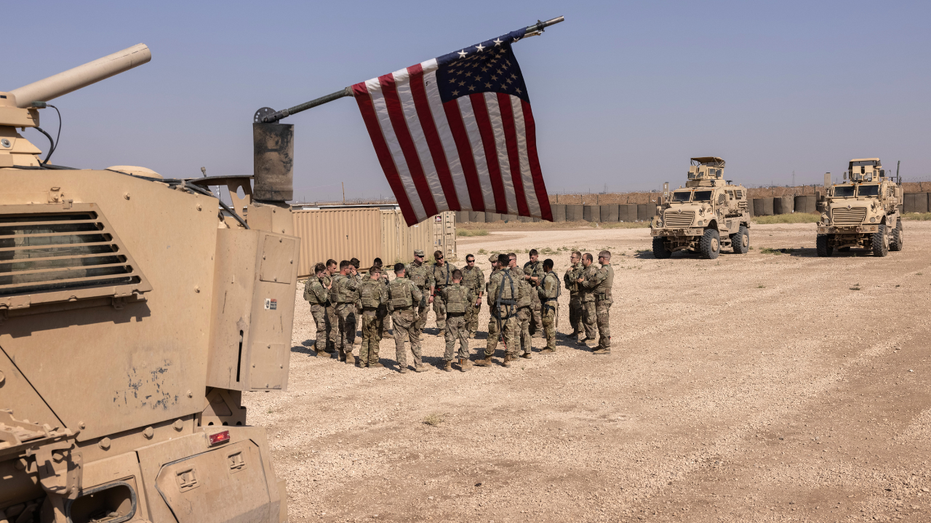
Multiple U.S. service members have been seriously wounded in an ambush near Palmyra, Syria, years after Washington tried to move Syria off the front page and out of the public mind. The attack is not just another battlefield incident; it is a reminder that the Syrian theater remains a live, lethal, and increasingly complex arena where great‑power competition, regional rivalries, and counterterrorism all intersect. It also exposes how little most Americans—and many elected officials—can currently explain about why U.S. troops are still there at all.
Understanding this ambush requires stepping back from the immediate violence and seeing three intertwined dynamics: the unfinished war against ISIS, the reshaped Syrian political order after Bashar al-Assad’s fall, and the shadow struggle between the U.S., Iran, Russia, Turkey, and local militias for control of the country’s strategic corridors.
The bigger picture: How we got to U.S. troops ambushed in Palmyra in 2025
To grasp the significance of this attack, you have to locate it in the arc of the Syrian conflict and U.S. policy over more than a decade.
- 2011–2013: Syria’s uprising morphs into civil war. The Assad regime responds with brutal force, regional powers back rival factions, and the West debates intervention but largely holds back.
- 2014–2019: ISIS seizes vast swaths of Syria and Iraq, declares a “caliphate.” The U.S.-led coalition intervenes militarily, partnering with Kurdish- and Arab-led Syrian Democratic Forces (SDF). The U.S. establishes a network of bases—ultimately eight—to support the campaign.
- 2020–2023: ISIS loses its territorial caliphate but survives as a dispersed insurgency. Iran-backed militias, Russian forces, Turkish troops, and a patchwork of rebel and Kurdish factions carve up influence zones. U.S. troops remain in eastern and southern Syria under a counter-ISIS mandate.
- 2024: The decisive turning point: Bashar al-Assad flees Damascus as rebel forces conduct a lightning offensive, ending five decades of Assad family rule. A new, still-fragile post-Assad order emerges, altering every major player’s calculations.
- 2025: U.S. troop levels, once around 2,000, fall to about 1,500 and are slated to drop to “several hundred.” Some bases are closed or handed to the SDF. Officially, the mission is narrow: prevent an ISIS resurgence. In practice, it now also involves stabilizing a post-Assad Syria in an environment where multiple armed actors are testing red lines.
Palmyra, the site of the ambush, is more than a dot on the map: it is a central Syrian crossroads linking Deir ez-Zor (an ISIS heartland area), Homs, and routes toward the Iraqi border. Under ISIS, it was both a propaganda symbol and a logistical hub. For whoever wants to control the flow of fighters, weapons, and commerce across Syria, Palmyra is a vital node.
What this really means: A mission that refuses to shrink
The ambush illustrates several deeper realities that are often absent from quick news hits.
1. The ISIS war is now an insurgency war—harder to see, but not over
The U.S. entered Syria in 2014 to stop ISIS from creating a territorial caliphate. That objective has been met. But the mission quietly shifted from defeating a state-like entity to suppressing an insurgency and managing a security vacuum.
Insurgencies are, by design, war by ambush: roadside IEDs, hit‑and‑run attacks, attacks on patrols like the one near Palmyra. They are sustained not only by ideology but by local grievances, economic collapse, and competition among armed groups. As troop numbers shrink and bases close, U.S. patrols become more exposed, less supported, and more reliant on local partners. That is exactly the type of environment in which attacks like this become more likely.
2. Post-Assad Syria is not post-conflict Syria
Western discourse often treats the fall of a dictator as a linear step toward peace and democracy. Syria’s experience after Assad suggests something more complicated.
The collapse of a highly centralized regime after five decades does not instantly produce a unified democratic government; it produces a scramble. Rebel factions, Islamists, local councils, remnants of the old security state, and external backers all compete to fill the vacuum. In some areas, that competition takes the form of relatively orderly political negotiations. In others, it looks like armed groups testing each other’s limits—and the limits of foreign forces.
The fact that tens of thousands of Syrians are celebrating Assad’s fall in Damascus while U.S. troops are being ambushed near Palmyra underscores a key reality: political symbolism in the capital has not yet translated into coherent security control nationwide.
3. A shrinking U.S. footprint can be more dangerous, not less
Washington has repeatedly tried to achieve a delicate balance: keep enough troops to prevent an ISIS comeback and retain leverage over Syria’s future, while steadily drawing down forces to reduce costs and risk. In practice, this “light footprint” strategy creates its own vulnerabilities.
- Fewer bases means longer, more exposed patrol routes.
- Smaller troops numbers mean less quick‑reaction capacity and thinner intelligence networks.
- Handing bases to local allies like the SDF is politically appealing, but it also creates gaps adversaries can probe.
Insurgent and rival state actors study these trends. They often choose to strike not at peak U.S. strength, but as Washington tries to disengage—when local partners are uncertain, and U.S. domestic attention is elsewhere.
4. The ambush as a message: to Washington and to rivals
We don’t yet know who precisely carried out this attack. But in Syria’s current landscape, such operations typically serve multiple purposes:
- Signaling to the U.S.: Demonstrating that any remaining presence comes with a price. This can be aimed at accelerating withdrawal or deterring deeper involvement in post-Assad political shaping.
- Signaling to local populations: Undermining the legitimacy of U.S.-backed forces by portraying them as unable to protect themselves, let alone civilians.
- Signaling to rival militias and states: Establishing a reputation for capability and daring, which can translate into greater funding, recruits, or territorial influence.
The fact that injured U.S. troops were reportedly evacuated to the al-Tanf garrison—a long-contested U.S. outpost near the Iraq-Jordan-Syria border—adds another layer. Al-Tanf has been a persistent irritant to Iran and the Syrian regime in past years because it sits astride key land routes that could allow Iran to move personnel and weapons across to Lebanon. The use of al-Tanf in the aftermath of the ambush underscores that the strategic geography of Syria has not fundamentally changed, even with Assad gone.
Expert perspectives: What specialists see in this attack
Counterterrorism and regional security experts view this attack as less a surprise and more a predictable manifestation of structural trends.
Dan Diker, of the Jerusalem Center for Security and Foreign Affairs, has already highlighted the depth of U.S. and CIA involvement in “securing and stabilizing” Syria. That dual role—both fighting ISIS and trying to shape a post-Assad order—magnifies the range of actors who might see U.S. personnel as high‑value targets.
Analysts who have studied insurgent patterns in Iraq and Afghanistan point to a familiar cycle: as Washington declares mission shrinkage, adversaries look for symbolic attacks that call that narrative into question. A serious ambush on a joint U.S.-Syrian patrol near an iconic location like Palmyra fits that pattern.
From a regional security lens, the attack also interacts with Israeli concerns. Recent rhetoric and military chants emerging from within elements of the Syrian military and allied militias have raised alarms in Israel about the trajectory of armed groups in Syria. Any perception that the U.S. presence is weakening or under pressure could embolden actors seeking to pressure Israel’s northern front or secure freer movement across Syria.
Data and evidence: The numbers behind a ‘small’ mission
Several datapoints help quantify what is otherwise framed as a minor residual presence:
- Troop levels: About 1,500 U.S. troops in Syria as of mid‑2025, with plans to reduce to several hundred. That is down from roughly 2,000–2,500 at the height of the anti-ISIS mission.
- Base footprint: Originally around eight U.S. positions in Syria; three have reportedly been closed or transferred to the SDF. Remaining sites, including al-Tanf and locations in the northeast, are now more critical nodes.
- ISIS activity: While precise current incident counts are not provided in this report, independent monitoring groups have consistently noted hundreds of ISIS-claimed or suspected attacks annually in Syria and Iraq even after the caliphate’s fall—largely ambushes, bombings, and assassinations.
- Casualty risk: A smaller footprint statistically reduces overall exposure but can increase the risk per patrol, especially in contested or symbolically important areas like Palmyra.
These figures challenge the notion that the U.S. role in Syria is negligible. On paper, the numbers are small; in practice, those forces are embedded in high‑risk environments with strategic consequences far beyond their headcount.
What’s being overlooked: The political vacuum and mission creep
Most immediate reporting focuses on who was injured, where they were evacuated, and whether ISIS was involved. Less attention is paid to two crucial issues.
The missing political strategy
With Assad gone, Washington and its allies have a window—possibly narrow—to influence Syria’s political trajectory. But the U.S. military presence remains primarily justified in counterterrorism terms, not nation-building or institution-building. That creates a dangerous disconnect: troops are caught in the crossfire of a broader political contest without a clearly articulated, publicly debated end state.
History offers a warning here. In Iraq and Afghanistan, extended missions framed primarily around counterterrorism gradually morphed into broader stabilization efforts without the matching civilian investment or public buy‑in. The casualty events that then occurred—troops killed or wounded in what the public had been told were winding-down wars—eroded domestic support and complicated strategic decision‑making.
The risk of fragmented security forces
Post-Assad Syria is rife with armed actors claiming counterterrorism credentials. Some are genuinely committed to stabilizing the country; others use the label to secure external support while pursuing narrow agendas. U.S. troops patrol alongside “Syrian forces” whose cohesion, loyalty, and local legitimacy may vary dramatically from one area to another.
Ambushes like the one near Palmyra can be exploited by rivals to question the competence of these local partners or to justify greater involvement by other powers—whether Iran, Russia, or Turkey—under the pretext of providing “real” security.
Looking ahead: What to watch in the weeks and months after the ambush
The immediate questions are about the condition of the injured service members and whether any group claims responsibility. But the strategic questions are broader.
- Will the U.S. adjust its drawdown plans? A serious attack could harden arguments within the Pentagon for maintaining a slightly larger footprint, at least temporarily, to deter further attacks and reassure local partners.
- Will there be overt retaliation? If the perpetrators are identified and linked to a known militia or ISIS cell, the U.S. may respond with airstrikes or targeted operations. How that response is framed—narrow counterstrike or broader warning—will signal Washington’s appetite for risk.
- How will local actors react? If Syrian partner forces appear shaken or incur heavy casualties, rival militias could test control of contested zones near Palmyra and beyond. Conversely, a strong joint response could reinforce the partnership.
- Will this spark a domestic debate? High‑profile injuries or deaths—especially if service members are identified publicly—could reignite U.S. domestic debate over why troops remain in Syria, what success looks like, and what obligations Washington has to post-Assad Syria beyond ISIS.
The bottom line
This ambush is not an isolated flare‑up in a distant desert. It is a symptom of a deeper reality: Syria remains a fractured, heavily militarized space where the U.S. is trying to do more with less—fight an enduring insurgency, shape a post-dictatorship order, and manage a multi‑actor regional contest, all with a shrinking footprint and limited public attention.
Whether this becomes a turning point depends less on the tactical outcome of the ambush and more on what Washington does next: reassess the mission with clear strategic goals, or continue to drift, hoping a “small” presence will avoid big consequences. History in the Middle East suggests that hoping is rarely a winning strategy.
Topics
Editor's Comments
What is most striking about this incident is not the tactical details—an ambush on a patrol in a historically contested area—but the degree to which it exposes the ambiguity of U.S. objectives in Syria. Officially, the mission is narrow and technical: counterterrorism against ISIS remnants. In reality, these troops are now sitting at the intersection of regime-change aftershocks, great-power rivalry, and regional proxy warfare. That mismatch matters. When a deployment is publicly sold as a limited, almost administrative task—"mopping up" extremists—every serious casualty shocks the domestic system and invites questions that should have been debated earlier: Are we shaping Syria’s future or just containing its worst excesses? How much risk are we willing to accept to marginally influence post-Assad outcomes? The risk is that, once again, U.S. forces become the default tool for managing political problems that lack a political strategy. This ambush should be a forcing event for a much more honest conversation about ends, means, and exit conditions.
Like this article? Share it with your friends!
If you find this article interesting, feel free to share it with your friends!
Thank you for your support! Sharing is the greatest encouragement for us.