
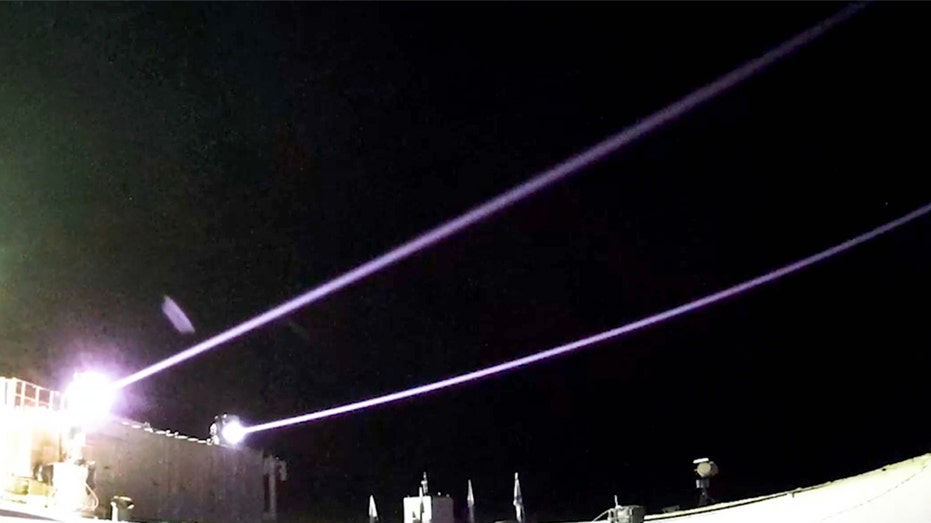
Iron Beam, Cheap Shots, and Costly Wars: How Israel’s $2 Laser Could Rewrite the Rules of Defense

Sarah Johnson
December 15, 2025
Brief
Israel’s Iron Beam laser and $15B in arms sales signal a deeper shift: a potential revolution in missile defense economics, U.S.–Israel tech symbiosis, and the geopolitics of ‘combat-proven’ weapons.
Israel’s Iron Beam and the $15B Question: How a Laser Weapon Could Reshape Global Warfare and the Arms Trade
Israel’s unveiling of the Iron Beam laser defense system, alongside a record $15 billion in arms exports, isn’t just another milestone in military technology. It signals a potentially profound shift in how wars are fought, how states think about deterrence, and who controls the most critical layers of the global defense market. The real story isn’t the headline-grabbing $2-per-shot laser; it’s how cost, credibility, and politics converge around this system to redraw the map of power and dependency in the 21st century.
Why This Story Matters
At first glance, Iron Beam looks like a simple upgrade to Israel’s already famous Iron Dome: faster, cheaper, and more precise. But underneath that narrative are at least four deeper developments:
- A historic price disruption in missile defense that could undermine the logic of rocket and drone warfare.
- A consolidation of Israel’s status as a top-tier arms exporter – not just regionally, but in Europe and Asia.
- A new phase in U.S.–Israel defense industrial integration, where Israeli systems become integral to American military planning.
- A fresh round of ethical and strategic dilemmas: does cheaper defense make conflict more likely or less?
How Israel Became a Small-State Arms Superpower
Israel’s rise to the world’s eighth-largest arms exporter is not an overnight success; it’s the product of decades of war, isolation, and necessity.
From its founding in 1948 through the 1973 Yom Kippur War, Israel relied heavily on foreign suppliers—first France, then the United States. But repeated arms embargoes in the 1960s and 1970s sent a clear message: survival could not depend purely on external goodwill. That shock catalyzed a strategic decision to build a self-reliant, technologically advanced defense industry.
By the 1980s and 1990s, Israel had moved from importer to innovator, focusing on niches where it had battlefield experience: UAVs (drones), electronic warfare, missile defense, and intelligence systems. The early combat use of drones in Lebanon in 1982, for example, gave Israel a long lead in an industry that is now global. Likewise, the Patriot missile’s mixed performance in the 1991 Gulf War pushed Israel to develop homegrown missile defense systems tailored to short-range rockets—eventually leading to Iron Dome.
Today’s $15 billion export figure sits on top of this history. European buyers like Germany and Finland are not merely shopping for hardware; they are buying access to a system that has been repeatedly tested under live fire in Gaza, Lebanon, and now against Iranian missiles and Hezbollah drones. In a world where many Western systems are optimized for peer conflict but rarely used under sustained daily attack, Israel’s “combat-proven” label has become a powerful commercial asset.
The Economics of a $2 Laser Shot
The most quoted statistic around Iron Beam is its estimated interception cost: about $1–2 per shot, compared with $100,000 to $1 million for a single interceptor missile. That discrepancy is not a minor budget detail; it strikes at the core economics of modern conflict.
For the past two decades, non-state actors like Hamas, Hezbollah, and the Houthis have relied on a basic asymmetry: cheap offensive weapons versus expensive defensive systems. A crude rocket might cost a few hundred dollars; shooting it down can cost hundreds of thousands. This “cost-imposition” strategy aims to exhaust the defender financially, even if the physical damage is limited by defenses.
If Iron Beam works at scale, that equation begins to invert. A defending state could, in theory, neutralize volleys of rockets and drones at marginal cost. That changes the strategic calculus for both sides:
- For attackers, flooding the skies with cheap munitions becomes far less attractive if each is neutralized for the cost of a cup of coffee.
- For defenders, political leaders may feel more comfortable accepting risk and prolonging conflicts, knowing their populations are better shielded at lower cost.
The catch: while the cost per shot is tiny, the cost per system is not. High-energy lasers require sophisticated optics, power generation, thermal management, and command-and-control integration. That means billions upfront in R&D and deployment, even if operating costs plummet. So the real gap may not be between $2 and $200,000; it may be between states that can afford the initial ecosystem—and those that can’t.
From Iron Dome to Iron Beam: What’s Really New?
Iron Dome revolutionized short-range missile defense by combining fast interceptors, radar, and algorithms that determine which incoming rockets will hit populated areas. It gave Israel more than protection; it gave decision-makers time and political space in crises.
Iron Beam takes that logic into a new physical domain. Instead of a kinetic interceptor, it uses a directed-energy weapon—a high-energy laser that, in principle, hits at the speed of light. That matters in three ways:
- Reaction time: Against very short-range rockets or fast drones launched near borders, every second counts. A laser with near-instantaneous engagement can target more projectiles in a compressed time window than interceptors that must be launched, guided, and maneuvered.
- Magazine depth: Missile batteries can run out of interceptors; resupply is slow and expensive. A laser’s “magazine” is limited by power and cooling, not missile stocks. In prolonged conflicts, that could be decisive.
- Scalability: If power generation and beam control continue to improve, multiple threats could be engaged almost simultaneously, especially if Iron Beam is networked with radars and other sensors already feeding Iron Dome and David’s Sling.
Yet lasers bring new vulnerabilities and constraints. Weather, atmospheric conditions, and dust can degrade effectiveness. High-energy beams need line-of-sight, making terrain and urban structures more important. Adversaries will adapt: they can use swarms, hardened casings, faster and more maneuverable drones, or simply wait for poor visibility conditions.
The U.S.–Israel Defense Tech Symbiosis
Iron Beam is not purely an Israeli achievement; it is a joint venture stitched into the broader fabric of U.S.–Israel defense cooperation. The reported $1.2 billion from the Pentagon and collaboration with Lockheed Martin reveal a pattern: Israel innovates under battlefield pressure; the United States brings scale, integration, and export reach.
This symbiosis has several implications:
- Standard-setting: If U.S. forces adopt variants of Iron Beam within their directed-energy programs, the system’s architecture, interfaces, and doctrines could become de facto standards in allied militaries.
- Industrial dependency: Just as many Israeli systems rely on U.S. funding and technology, U.S. programs may increasingly rely on Israeli intellectual property and combat data. That interdependence complicates any political effort in Washington to condition or restrict military cooperation.
- Export politics: If the U.S. Army fields an Iron Beam derivative, Washington and Jerusalem will have to manage export controls together—balancing commercial demand (from Europe, India, Gulf states) against concerns about proliferation and escalation.
Why Europe Is Buying Israeli, Not Just American
Germany, Finland, Greece, and others lining up for Israeli systems reflects more than the search for discount hardware. Europe, especially since Russia’s invasion of Ukraine, is scrambling to rebuild air and missile defenses against a spectrum of threats: cruise missiles, drones, ballistic missiles, and cheap loitering munitions.
European governments see three advantages in Israeli offerings:
- Combat-proven performance under high-volume, real-world conditions that NATO systems rarely face in peacetime.
- Speed of delivery and customization from a smaller, more agile industrial base that can adapt to specific national requirements.
- Political signaling: purchasing from Israel often complements, rather than substitutes for, U.S. systems—reinforcing transatlantic ties without deepening dependence on any single supplier.
For Israel, Europe’s embrace is also geopolitical insurance. As criticism over the conduct of its military operations grows in some Western capitals, deep defense-industrial ties make full-scale diplomatic ruptures less likely. Once you rely on another state for key layers of your air defense, disengaging becomes very costly.
Arab Normalization Through the Back Door of Defense
That Muslim-majority states like Morocco, the UAE, and Bahrain are buying Israeli systems is one of the most underappreciated dimensions of this story. Arms sales are rarely just commercial; they are security commitments in disguise.
The Abraham Accords opened diplomatic channels, but defense technology seals them. When Gulf or North African states integrate Israeli radar, drones, or cyber tools into their forces, they are not simply normalizing; they are wiring their security architectures to Israel and, indirectly, to the United States. That creates:
- Shared threat frameworks centered on Iran, proxies, and drones.
- Intelligence interoperability as systems share data formats and protocols.
- Political sunk costs that make reversing normalization harder over time.
In this sense, Iron Beam is not just a weapon; it’s a potential platform for regional security integration—especially if naval or base-defense variants are deployed around the Gulf or eastern Mediterranean.
The Risks: Arms Races, Moral Hazard, and Civilian Protection
Advanced missile defense has always carried inherent paradoxes. On one hand, it protects civilians and critical infrastructure. On the other, it can encourage risk-taking by leaders who feel shielded from retaliation. Iron Beam intensifies that tension.
First, the arms race problem. If Israel can cheaply intercept rockets and drones, adversaries will respond by:
- Building larger, more concentrated salvos to saturate defenses.
- Investing in stealthier or hypersonic systems that lasers struggle to hit.
- Shifting to targets and tactics that bypass high-tech defenses entirely—such as cyberattacks, terrorism, or infrastructure sabotage.
Second, the moral hazard problem. When civilian casualties from rocket attacks decrease due to better defenses, international pressure on governments to end conflicts may weaken. A leadership that feels its cities are protected may be more willing to accept prolonged low-intensity conflict rather than pursue risky diplomacy.
Third, the inequality problem. Only wealthy states will be able to afford fully integrated laser networks. Poorer countries facing drone and rocket threats—from militias, insurgents, or neighboring states—may be left with outdated systems, widening the gap between those who can protect their populations and those who cannot.
What Mainstream Coverage Often Misses
Much reporting on Iron Beam focuses on the tech itself—the beam, the cost per shot, the “sci-fi” angle. What it tends to underplay are the structural consequences:
- Doctrinal shifts: Laser defenses could eventually push air forces and navies to rethink their reliance on manned platforms and expensive missiles, accelerating the move to autonomous, swarming, and expendable systems.
- Export leverage: States that control key layers of integrated air and missile defense will have disproportionate political influence over their clients—especially in crises where continued support and software updates are critical.
- Norms and law: As directed-energy weapons proliferate, existing legal frameworks—designed around kinetic weapons—will struggle to keep up, from rules of engagement to verification and arms control.
Looking Ahead: Five Things to Watch
- Operational transparency: How much hard data will Israel and its partners release on Iron Beam’s performance—hit rates, weather limitations, failure modes? That will determine whether the system becomes a global standard or a niche tool.
- Export policy fights: Expect intense lobbying from European, Asian, and Gulf states, and equally intense debates in Washington and Jerusalem about where to draw the line on sharing such disruptive capability.
- Adversary adaptation: Watch how Hezbollah, Iran, and other actors adjust—more drones, different trajectories, or a pivot toward cyber and ground-based asymmetry.
- U.S. uptake: The speed and scale at which the U.S. Army and Navy field directed-energy systems informed by Iron Beam will be a key indicator of how transformative Washington believes this technology really is.
- Arms control discourse: As more states pursue directed-energy weapons, there will be growing pressure for some form of norms or agreements, even if formal treaties remain unlikely.
The Bottom Line
Iron Beam is more than a flashy new weapon. It represents a potential tipping point in the economics of missile defense, a consolidation of Israel’s status as a global arms power, and a new chapter in U.S.–Israel defense integration. It could save lives by neutralizing rockets and drones at unprecedented speed and scale. It could also deepen arms races, widen the gap between rich and poor states, and lower the political costs of prolonged conflict.
As with every leap in military technology, the crucial questions are not only what the system can do, but who controls it, who can afford it, and how it reshapes the incentives of those who go to war—and those who try to avoid it.
Expert Perspectives
These perspectives synthesize the views of leading scholars and practitioners in defense technology and strategy.
- On strategic stability: A scholar like Prof. Laura Grego, who has written extensively on missile defense, would likely warn that any perception of near-impenetrable defense risks spurring adversaries to develop more offensive capabilities rather than less, particularly in the absence of arms control mechanisms.
- On regional dynamics: Analysts in the Gulf have noted that integrating Israeli systems is as much about politics as security—quietly binding Arab states into a shared security architecture that may outlast formal diplomatic ups and downs.
- On technology diffusion: Defense industry experts emphasize that once one credible laser system enters the battlefield, competitors—from the U.S. and Europe to China and Russia—will accelerate their own programs, making directed energy a central battleground of tech competition in the 2030s.
Data & Evidence Snapshot
- Israel ranks among the top ten global arms exporters, with exports reportedly reaching around $15 billion in 2024, a substantial jump from the roughly $12–13 billion range estimated in recent years.
- Per-intercept cost comparison: Iron Beam’s projected $1–2 versus $100,000–$1,000,000 for many traditional interceptor missiles reflects a shift of 5–6 orders of magnitude in marginal cost.
- Global trend: Over 100 countries now operate military drones; directed-energy defenses are emerging as the next competitive frontier in counter-UAV capabilities.
Topics
Editor's Comments
One under-discussed aspect of Iron Beam is how it fits into the broader narrative of unequal access to security. For wealthier states, a future of layered missile defense—combining interceptors, lasers, electronic warfare, and cyber defenses—promises unprecedented protection for their populations. For poorer states facing similar threats, that future will remain out of reach. This raises uncomfortable questions: are we moving toward a world where some societies can largely insulate themselves from the physical costs of conflict while others absorb the brunt of violence? If so, the political incentives diverge. Societies that feel secure behind advanced defenses may be less motivated to pursue structural conflict resolution, while vulnerable states and populations carry disproportionate risk and trauma. Any serious discussion of laser defenses like Iron Beam should grapple not only with strategic stability among major powers, but also with the justice implications of who gets to buy safety—and who is left exposed.
Like this article? Share it with your friends!
If you find this article interesting, feel free to share it with your friends!
Thank you for your support! Sharing is the greatest encouragement for us.