From Prison to the Big Screen: How a Bolsonaro Biopic and His Son’s 2026 Run Rewrite Brazil’s Recent Past

Sarah Johnson
December 12, 2025
Brief
Jim Caviezel’s Bolsonaro biopic and Flávio Bolsonaro’s 2026 bid reveal a coordinated strategy to recast a convicted ex-president as a persecuted hero and preserve his political project through dynastic succession.
Bolsonaro, Hollywood and the Battle to Rewrite Brazil’s Recent Past
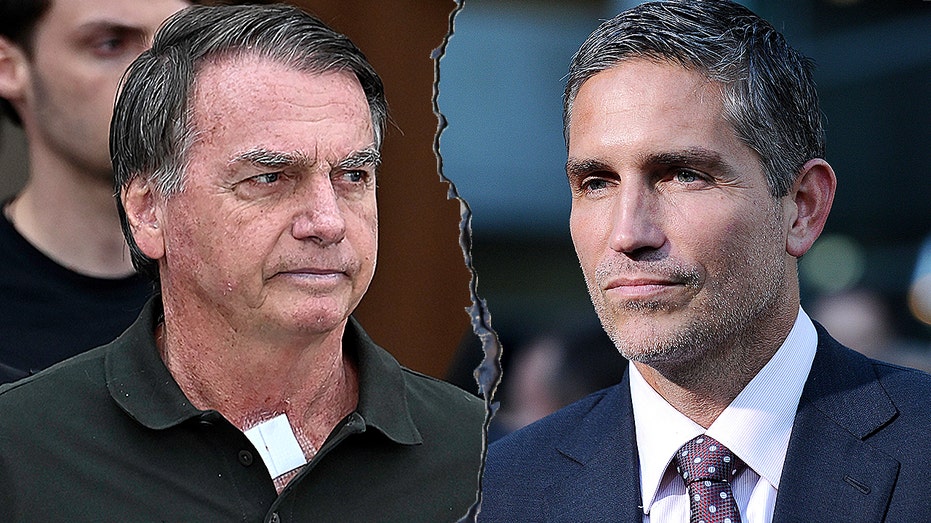
Jair Bolsonaro may be in prison and legally barred from office, but the fight over his legacy is only intensifying. A glossy biopic starring Jim Caviezel and the 2026 presidential bid of his son Flávio are not unrelated developments; they are two fronts in a coordinated struggle to recast one of Latin America’s most polarizing figures as a persecuted hero—and to keep his political project alive after his formal fall.
The convergence of a U.S. culture-war actor, a jailed ex-president convicted over an attempted coup, and a dynastic presidential handover in Brazil reveals something larger: we are watching the globalization of the “Trumpist” playbook, where cinema, martyrdom, and family succession are woven into a single narrative strategy.
Bolsonaro’s Biopic as Political Weapon, Not Entertainment
“Dark Horse,” directed by Cyrus Nowrasteh and written by former Bolsonaro culture secretary Mário Frias, is not an ordinary biographical film. Its timing—produced while Bolsonaro is serving a 27-year sentence over his role in efforts to overturn the 2022 election—and its creative team suggest a clear political intent: to rewrite Bolsonaro’s rise as a heroic saga at the very moment courts, commissions and historians are documenting his role in democratic backsliding.
Biopics have long functioned as soft power tools. From hagiographic films about U.S. presidents to nationalist depictions of independence leaders in postcolonial states, cinema shapes the emotional memory of political figures. What’s different here is that “Dark Horse” is being developed amid an ongoing constitutional crisis, not after the dust has settled. It aims to influence how Brazilians and international audiences interpret events that are still unfolding, rather than offering retrospective interpretation.
That it focuses on Bolsonaro’s 2018 campaign—not his pandemic management, environmental record, or the January 8, 2023 assault on Brasilia’s institutions—suggests a deliberate narrowing of the lens to his outsider, anti-establishment appeal. This is the “origin story” phase, where his image can be framed as a righteous crusade against corruption and elite privilege, largely sidestepping the subsequent controversies that led to his downfall.
Historical Echoes: From Strongman Mythmaking to Family Succession
Latin American politics offers a long history of leaders using culture and family to sustain power. Juan Perón and Eva Perón became almost mythological figures via stage, film, and music; their symbolic power outlived their time in office and repeatedly reshaped Argentine politics. In Nicaragua, Daniel Ortega has built a governing structure in which his family is embedded in media, business and government, blurring lineages of power and narrative.
Bolsonaro’s movement is attempting something similar, but updated for the digital age. The family brand—Jair plus sons Flávio, Carlos and Eduardo—functions like a political franchise with multiple spokes:
- Jair as the martyr-leader in prison, symbol of “persecuted conservatism.”
- Flávio as the presidential heir and political executor of his father’s “mission.”
- Carlos as media-strategist and online amplifier, now also co-architect of international cinematic storytelling.
This dynastic approach has precedents in Brazil. The country has seen political families—Sarney, Neves, Calheiros—wield influence across generations. What’s new is the explicit fusion of a global culture-war narrative, conspiracy-adjacent U.S. entertainment figures, and an attempt to canonize an ex-president convicted of trying to overturn an election.
Why Jim Caviezel Matters in This Story
Jim Caviezel isn’t just any well-known actor. His public persona has increasingly aligned with hard-right, Christian nationalist and conspiracy-tinged causes in the United States. After “The Passion of the Christ,” he became a spiritual-cultural figure for many conservative Christians. His more recent association with “Sound of Freedom”—embraced by segments of the U.S. far right and conspiracy communities—cemented his status as a kind of cinematic apostle in a political-religious ecosystem that blends faith, anti-globalism, and anti-elite sentiments.
Casting Caviezel as Bolsonaro does two things:
- Religious framing: It subtly maps evangelical and Catholic martyr imagery onto Bolsonaro’s story. For supporters, a jailed Bolsonaro played by the actor best known for portraying Jesus invites analogies of persecution, sacrifice and redemption.
- Transnational culture-war alliance: It connects Brazilian Bolsonarismo to a broader U.S.-driven conservative media universe. Bolsonaro’s story is no longer just Brazilian; it is a chapter in a global narrative of supposed “Christian patriots” resisting liberal or leftist elites.
For Bolsonaro’s core base—largely evangelical, culturally conservative, and deeply online—this is not about convincing skeptics. It is about deepening loyalty among the faithful and exporting their narrative to sympathetic audiences abroad, including potential funders, influencers, and allied politicians.
The Criminal Sentence vs. the Cinematic Redemption Arc
While cameras roll, legal reality tells a very different story. Bolsonaro’s 27-year sentence stems from his role in a plot to invalidate the 2022 election, part of a broader pattern of democratic erosion that included disinformation campaigns, attacks on electoral institutions, and, ultimately, the January 8 attack on Brasilia, widely compared to the January 6, 2021 U.S. Capitol assault.
Democratic backsliding scholars like Steven Levitsky and Daniel Ziblatt have noted how modern autocrats rarely seize power in a single dramatic blow. Instead, they chip away at norms, undermine electoral integrity, and attack referees like courts and electoral commissions. Bolsonaro’s post-election behavior fits this pattern. Brazilian courts have responded unusually forcefully by regional standards, not only prosecuting him but also barring him from running for office until 2030.
Against this, “Dark Horse” offers a counter-narrative: the heroic outsider victimized by a vengeful system. That narrative is politically potent because it allows supporters to reconcile cognitive dissonance. If they see Brazil’s judiciary as politicized, then legal sanctions become proof of Bolsonaro’s righteousness, not evidence of wrongdoing.
Flávio Bolsonaro’s 2026 Bid: Succession, Not Renewal
Flávio’s announcement that he will run in 2026 “with the mission of continuing our national project” is less a generational renewal than a formal coronation. Bolsonaro has explicitly endorsed Flávio from prison, framing the transition as a delegation of a sacred trust rather than a pragmatic political pivot.
That matters for Brazil’s democracy for three reasons:
- Continuity of rhetoric: Flávio’s appeal is built not on a distinct policy platform, but on continuity with a leader convicted in connection with an attempted coup. This normalizes the idea that overturning elections can be folded into a broader conservative project without discrediting it.
- Institutional pressure: A strong showing by Flávio—even if he loses—would keep relentless political pressure on Lula’s government and on judicial institutions. Every court ruling against Bolsonaro or his allies could be reinterpreted as persecution of a movement, not adjudication of law.
- Dynastic entrenchment: If Flávio performs well, it cements the Bolsonaro surname as a durable political brand, encouraging the family to keep mobilizing around the patriarch’s imprisonment as a rallying symbol.
Opinion polling will be crucial. Lula remains a polarizing figure himself—popular among many working-class and left-leaning Brazilians, but deeply distrusted by parts of the middle class and conservative voters. Economic performance and perceptions of crime, corruption and inflation by 2026 will heavily influence whether Bolsonaro’s movement can capitalize on discontent.
The Overlooked Story: Culture as Infrastructure for Authoritarian Temptation
Much mainstream coverage will treat the Caviezel casting as odd or sensational, and Flávio’s run as just another twist in Brazil’s turbulent politics. What tends to be missed is how cultural products like “Dark Horse” function as infrastructure for illiberal politics, not mere commentary on it.
Films, streaming series, and social media content help build an emotional universe in which certain political positions feel morally obvious. If Bolsonaro is framed as a godly warrior against evil forces, then judicial institutions pursuing him can be painted as corrupt or satanic. In this moralized framing, compromise becomes betrayal, and democratic rules look negotiable if they stand in the way of “God, Jesus and Freedom” – language Carlos Bolsonaro himself uses publicly.
This is not a uniquely Brazilian phenomenon. We’ve seen similar dynamics in U.S. conservative media, Russian state-backed cinema, Indian nationalist blockbuster films, and Turkish television dramas that rehabilitate imperial or religious nostalgia. What’s distinctive in Brazil’s case is how quickly this cinematic narrative is being deployed to contest a very fresh, judicially documented history of an attempted power grab.
International Ripple Effects: Trumpism, Sanctions and Soft Power
The Bolsonaro case is already entangled with international politics. U.S. lawmakers have warned Brazil about the implications of his conviction; Washington has imposed sanctions on a Brazilian judge involved in coup-plot investigations. These moves are often framed domestically as foreign interference, which Bolsonaristas use to fuel nationalist resentment.
At the same time, Bolsonaro’s alliance with U.S. right-wing figures, including Donald Trump and parts of the MAGA ecosystem, means “Dark Horse” will likely circulate in U.S. conservative circuits as a Brazilian version of the Trump story: the populist hero betrayed by the establishment. Caviezel’s presence all but guarantees that overlap.
This entwines Brazil’s domestic information environment with the U.S. culture war. Mis- and disinformation about Brazil’s elections and courts may increasingly be shaped by English-language conservative media, not just Brazilian outlets, complicating efforts by Brazilian authorities and civil society to maintain a fact-based debate.
What to Watch Between Now and 2026
Several fault lines will determine whether this mix of cinema and dynastic politics reshapes Brazil’s trajectory or fizzles out:
- Judicial resilience: Will Brazil’s Supreme Court and electoral authorities maintain their current assertiveness, or will political and international pressure force them into caution that emboldens Bolsonaro’s movement?
- Evangelical leadership: Pastors and evangelical media organizations will be key amplifiers or dampeners of the Bolsonaro-as-martyr narrative. Their stance toward Flávio’s candidacy could significantly shift the electoral math.
- Reception of “Dark Horse” in Brazil: If the film is perceived as crude propaganda, it may preach mainly to the converted. If it manages to tap into genuine frustration with corruption, inequality and crime, it could broaden sympathy for the Bolsonaro project beyond the hardcore base.
- Economic and social indicators: Lula’s ability to deliver on growth, jobs, inflation control and social welfare will heavily influence whether voters see Flávio as a dangerous continuation or a needed correction.
The Bottom Line
Bolsonaro’s imprisonment did not end Bolsonarismo. Instead, it has pushed the movement into a new phase: one in which cinema, religious symbolism and family succession are strategically deployed to reframe a convicted ex-president as a persecuted hero and to keep his political project alive through his son.
“Dark Horse” is best understood not as a mere biopic, but as a campaign film in disguise—a long-form narrative designed to shape the emotional terrain on which Brazil’s 2026 election will be fought. For democracies watching from afar, Brazil is becoming a test case for whether robust institutions and civic vigilance can withstand a sophisticated blend of dynastic politics and culture-war storytelling.
Topics
Editor's Comments
One angle that deserves more public scrutiny is how films like “Dark Horse” exploit a structural asymmetry in democratic politics. Courts and electoral commissions must communicate in dense legal language, bound by evidence and procedure. Cultural producers face no such constraints. They can compress complex histories into emotionally satisfying narratives in which facts are selectively edited, timelines rearranged, and opponents caricatured. That doesn’t mean democracies should respond with state-sponsored propaganda; the cure would be worse than the disease. But it does raise uncomfortable questions about whether civil society, independent media and educators are equipped to counteract sophisticated political mythmaking, especially when it is wrapped in religious symbolism and backed by transnational networks. If Brazil’s experience shows anything, it is that protecting democracy in the 2020s and beyond will require not just strong institutions, but a far more deliberate engagement with the cultural battleground where public memory is forged.
Like this article? Share it with your friends!
If you find this article interesting, feel free to share it with your friends!
Thank you for your support! Sharing is the greatest encouragement for us.