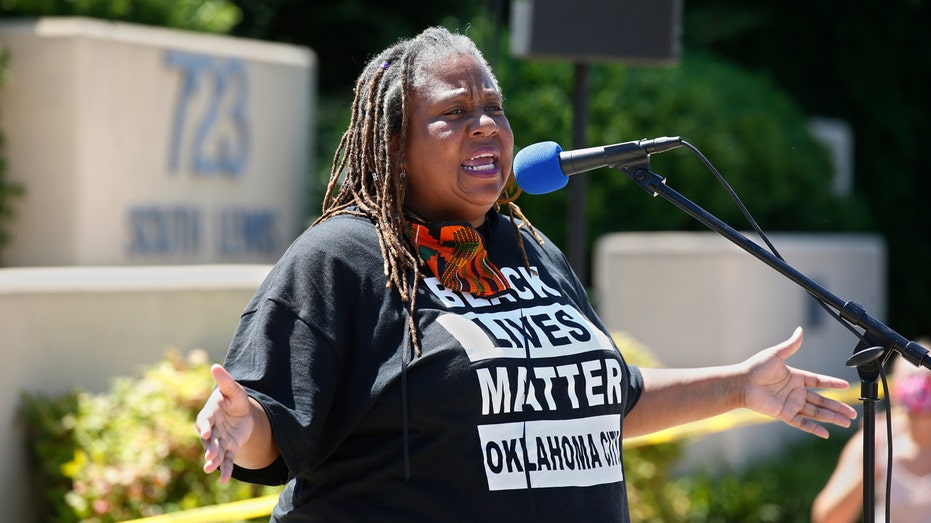
Beyond the BLM OKC Fraud Allegations: How Movement Money, Bail Funds, and Decentralization Collided

Sarah Johnson
December 12, 2025
Brief
The alleged $3.15M fraud at BLM OKC is more than a scandal. It exposes structural weaknesses in bail funds, fiscal sponsorship, and decentralized movements with major implications for racial justice organizing.
BLM OKC Fraud Charges Expose a Deeper Crisis in Movement Money, Bail Funds, and Public Trust
The indictment of Black Lives Matter Oklahoma City (BLM OKC) executive director Tashella Sheri Amore Dickerson is about far more than one leader allegedly siphoning $3.15 million in bail fund money for luxury travel, real estate, and consumer spending. It touches three flashpoints in American public life: the integrity of social justice movements, the fragile legitimacy of charitable bail funds, and a growing backlash against Black-led political organizing.
Whatever the legal outcome for Dickerson, the case is already being weaponized in political debates. To understand what’s really at stake, we have to zoom out: to the 2020 protest wave, the boom-and-bust cycle of BLM philanthropy, the long history of financial scandals in advocacy organizations, and the policy battle over whether bail reform is a public good or a public threat.
Why This Case Matters Beyond Oklahoma City
According to federal prosecutors, Dickerson used her access to BLM OKC’s financial infrastructure—bank accounts, PayPal, Cash App, and control over returned bail checks—to divert at least $3.15 million into her personal accounts between 2020 and 2025. Those funds came largely from national bail funds and allied organizations that routed money through a fiscal sponsor, the Alliance for Global Justice (AFGJ), with 501(c)(3) restrictions.
If proven, this is not just garden-variety nonprofit mismanagement. It strikes at the core of a core 2020 promise: that hundreds of millions of dollars raised in the name of Black lives would materially benefit people facing police violence, criminalization, and incarceration.
The indictment raises four critical questions:
- Can decentralized movement structures reliably guard against large-scale financial abuse?
- Are fiscal sponsors and donors equipped to monitor high-risk, high-volume grantmaking during crisis moments?
- Will alleged misconduct by a few actors delegitimize bail funds and Black-led organizing in the eyes of the public and policymakers?
- What reforms are needed so that future surges of solidarity money don’t disappear into opaque financial structures?
From 2020 Uprising to 2025 Indictment: The Bigger Picture
BLM OKC’s fundraising spike mirrors a national pattern. After the murder of George Floyd in May 2020, donations to racial justice causes exploded. Analysts estimate that U.S. corporations and philanthropic institutions pledged more than $50 billion toward racial equity initiatives in 2020–2021. The Black Lives Matter Global Network Foundation (BLMGNF) alone reported collecting roughly $90 million in 2020.
Local chapters and aligned groups often lacked the infrastructure to handle this influx. Many were small, activist-driven organizations that suddenly found themselves managing sums of money that would challenge even seasoned nonprofits. To comply with IRS rules and receive foundation grants, a number of them turned to fiscal sponsors like AFGJ, who allowed them to operate under existing 501(c)(3) umbrellas while they built (or attempted to build) their own legal and financial capacity.
Historically, this model has enabled nimble movement-building—from antiwar coalitions to immigrant rights groups. But it also creates structural vulnerabilities:
- Complex money flows: Donors give to funders; funders give to a fiscal sponsor; the sponsor regrants to local groups; those groups then manage bail funds or mutual aid projects with limited oversight capacity.
- Blurred accountability: Local chapters often present themselves to the public as autonomous, but are legally tethered to fiscal sponsors with formal compliance obligations.
- Crisis conditions: During uprisings, decisions are made quickly, record-keeping is strained, and systems are retrofitted on the fly.
In that context, BLM OKC’s alleged misconduct looks less like a bizarre anomaly and more like an extreme example of a structural risk: large, fast money flowing through under-governed, politically controversial organizations.
The Vulnerable Architecture of Bail Funds
Bail funds were at the heart of 2020’s mutual aid response. Donors wanted a direct, tangible impact: get protesters out of jail. Organizations like the Minnesota Freedom Fund and Massachusetts Bail Fund saw unprecedented contributions—tens of millions of dollars in some cases.
When bail is posted, and the case concludes without a forfeiture, those funds are often returned. Many bail funds use that returned bail to build a revolving pool, allowing each donated dollar to be redeployed multiple times. That practice is both efficient and legally complex; it requires meticulous accounting and clear agreements about who owns the returned money: the individual, the fund, or some mix of both.
Prosecutors say misconduct in the BLM OKC case began precisely at this point—when national and regional bail funds allowed the local group to retain returned bail funds to build a revolving bail fund or support its mission. That creates an underappreciated risk:
- Returned bail checks are high-volume, relatively low-visibility transactions.
- Donors and fiscal sponsors often focus on front-end grants, not back-end returns.
- A single individual with access to accounts can allegedly divert large sums over time without obvious public red flags.
Put differently, one of the most innovative mechanisms of the movement—revolving bail—also created a hidden vulnerability. It’s analogous to microfinance or revolving loan funds: extremely powerful when well-governed, extremely ripe for abuse when they’re not.
Decentralized Leadership vs. Centralized Risk
In response to questions about the indictment, a BLM Global Network Foundation spokesperson emphasized that the Foundation and local chapters operate independently under a model of “decentralized leadership.” That distinction is legally accurate and politically strategic. It’s also at the heart of a paradox facing modern movements.
Decentralization has been a hallmark of BLM since its inception—designed to avoid the hierarchy and gatekeeping that plagued earlier civil rights organizations, and to embody the horizontal, intersectional politics of younger activists. But when large sums of money are involved, that structure can clash with donor expectations and regulatory demands.
We’ve been here before:
- The Occupy Wall Street movement struggled with accountability around donated funds due to its leaderless structure.
- Earlier generations of Black liberation movements sometimes used informal or opaque funding channels to avoid state surveillance—only to face repression framed as “financial crimes.”
- Environmental and animal rights movements have long negotiated tensions between grassroots networks and professionalized nonprofit arms.
The Dickerson indictment will intensify pressure on BLM-affiliated groups to choose between two imperfect options:
- Maintain radical decentralization and accept heightened risk of both internal misconduct and external attacks on legitimacy.
- Move toward more centralized, professional nonprofit models, risking bureaucratization and alienation from grassroots base.
Neither path fully resolves the underlying problem: how to build movements that are both accountable and agile, both transparent and resilient to political harassment.
What’s Being Overlooked in the Early Coverage
Most early reporting focuses on the sensational details: trips to Jamaica and the Dominican Republic, six properties, tens of thousands in retail spending, more than $50,000 on food delivery. That framing risks obscuring three crucial dimensions.
1. The Structural Audit Gap
Fiscal sponsors like AFGJ required that funds be used for tax-exempt purposes and prohibited real estate purchases without approval. They also required periodic reports—which, according to prosecutors, Dickerson allegedly falsified. But the indictment suggests that the oversight mechanism relied heavily on self-reporting and did not involve routine, independent audits of underlying transactions.
This is not unique to BLM. Across the nonprofit sector, particularly in fiscally sponsored projects, oversight often consists of paperwork, not proactive forensic review. High-trust, paper-based systems work reasonably well in low-conflict domains. In politicized spaces—where both genuine misconduct and politically motivated investigations are common—they are inadequate.
2. The Risk of Political Overreaction
Conservatives already skeptical of BLM and bail reform are likely to point to this case as proof that movement organizations are inherently corrupt or that donor funds will inevitably be misused. History suggests such scandals are routinely used to justify broader rollbacks:
- In the 1990s, welfare fraud narratives helped fuel cuts and restrictions to public assistance programs, even though verified fraud rates were relatively low.
- Isolated abuses in community development programs have been used to argue that government should defund entire categories of anti-poverty work.
We should expect attempts to use the Dickerson case to undermine bail funds as a whole—despite the fact that many have robust internal controls and publish detailed public reports.
3. Donor and Philanthropic Accountability
The indictment doesn’t just raise questions about BLM OKC. It raises questions about the national organizations and foundations that moved millions quickly into volatile environments. After 2020, many donors shifted from cautious, incremental grantmaking to rapid, large-scale disbursements in response to public pressure and moral urgency.
Yet few have been equally public about what they learned when things went wrong. Did grantmakers require independent audits? Did they fund back-office infrastructure, not just frontline activism? Did they adapt their practices after earlier controversies, such as the $6 million property purchase by BLMGNF that sparked transparency debates in 2022?
Expert Perspectives and Competing Interpretations
Experts who study nonprofit governance, social movements, and criminal justice see the BLM OKC case through different lenses.
For nonprofit law scholars, the indictment underscores the chronic underinvestment in financial controls for groups handling large sums in short time frames. They point to best practices—segregation of duties, regular third-party audits, board-level financial literacy—that are difficult to implement in small, activist-led entities without dedicated operational funding.
Criminal justice reform advocates worry about collateral damage. They argue that bail funds have been one of the most effective tools for challenging pretrial detention and racialized incarceration. When scandals hit, opponents of reform seize on them to argue that bail funds are reckless or dangerous, ignoring robust data showing that most people return to court when released and that community-based support often outperforms cash bail.
Movement historians emphasize the cyclical nature of these controversies. From the civil rights era to the present, high-profile accusations of financial impropriety have frequently emerged at moments when Black-led organizations gain influence and resources. Some of those accusations have been fully justified; others have been exaggerated or selectively enforced. In every case, they’ve had long-term repercussions for public trust and philanthropic willingness to fund disruptive work.
Data, Context, and the Scale of the Allegations
BLM OKC reportedly raised more than $5.6 million since 2020. The indictment alleges that at least $3.15 million in returned bail checks were diverted to Dickerson’s personal accounts—more than half the organization’s total reported fundraising during that period. If accurate, that would make this one of the largest known instances of alleged fraud tied to a local BLM-affiliated entity.
The potential penalties are severe: up to 20 years per wire fraud count (20 counts) and up to 10 years per money laundering count (5 counts), plus fines. In practice, sentences in federal fraud cases are driven by guidelines that consider loss amount, role in the offense, and criminal history; they rarely approach the mathematical maximum. Still, the charging posture signals that federal authorities view this as serious, long-running conduct rather than a one-off lapse.
It’s also notable that the case was investigated jointly by the FBI and IRS Criminal Investigation. That combination is typical in complex financial crime cases and suggests a focus not only on the misdirection of funds but on how that money was moved, possibly laundered, and reported (or not) for tax purposes.
Where This Could Go Next
Several developments are worth watching in the months and years ahead:
- Plea or trial: Will Dickerson fight the charges and force a public trial that could expose internal dynamics at BLM OKC and its funders? Or will she seek a plea deal that leaves many questions unanswered?
- Civil and regulatory fallout: Independent of the criminal case, the IRS and state charity regulators could scrutinize not only BLM OKC, but AFGJ and other fiscal sponsors that managed bail and protest-related funds.
- Reforms in movement infrastructure: We may see a push for standardized financial controls for movement bail funds—shared accounting services, pooled compliance teams, or centralized reporting platforms.
- Political use of the case: Lawmakers pushing anti-protest bills or rollbacks on bail reform are likely to cite this indictment as evidence of systemic abuse, regardless of its outcomes.
- Donor behavior: Major foundations and corporate donors may further retreat from front-line movement funding, shifting toward safer, institutional partners—potentially blunting the radical edge of racial justice work.
The Bottom Line
The Dickerson indictment is not a referendum on the legitimacy of Black Lives Matter as an idea or the value of bail funds as a tool for justice. It is, however, a stark warning about how quickly public trust can be undermined when movements that preach accountability fail to model it internally.
The challenge ahead is not simply to punish wrongdoing if it is proven, but to redesign the financial architecture of movements so that fraud is harder, transparency is easier, and donors can support transformative work without wondering whether their money will end up paying for luxury vacations and real estate portfolios.
For communities that continue to face aggressive policing and punitive bail systems, the stakes could not be higher: if high-profile scandals like this one lead to the stigmatization or dismantling of bail funds and grassroots organizations, the people most harmed will not be the leaders accused of misconduct, but those who once relied on these structures to get out of a jail cell and back to their lives.
Topics
Editor's Comments
What makes the BLM OKC indictment especially consequential is not just the alleged dollar amount, but the timing and symbolic weight. The 2020–2021 period was a rare moment when mainstream institutions conceded that systemic racism in policing and criminal justice required more than rhetoric; they wrote checks. A portion of that money appears to have been mishandled in ways that confirm every cynic’s suspicion about ‘activist grifters.’ Yet the dominant narrative risks missing the structural trap everyone walked into—activists hungry for resources, donors eager to show solidarity, and intermediaries trying to scale up overnight. If we reduce this to a morality tale about one individual’s greed, we will almost certainly repeat the core mistake the next time a social crisis sparks a philanthropic surge. The more uncomfortable but necessary question is: why do we keep building movement finance systems that depend on trust in a context defined by mistrust—of the state, of institutions, and increasingly of movements themselves?
Like this article? Share it with your friends!
If you find this article interesting, feel free to share it with your friends!
Thank you for your support! Sharing is the greatest encouragement for us.