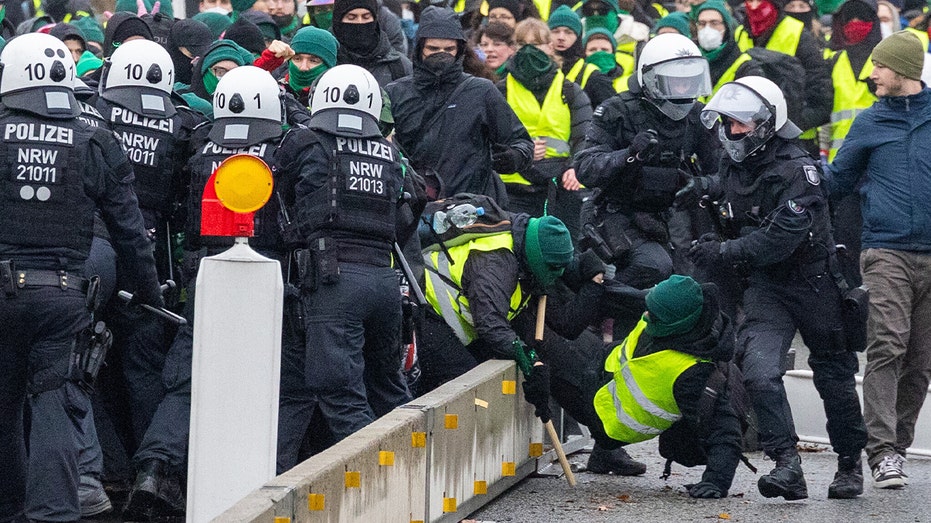
Antifa Violence in Germany Deepens Divides as Trump Labels Movement Foreign Terror Threat

Sarah Johnson
December 3, 2025
Brief
In-depth analysis of violent Antifa protests in Germany against AfD youth, exploring implications of rising far-right populism, political polarization, and the Trump administration's foreign terrorist designation of Antifa.
Opening Analysis
The recent violent clashes in Giessen, Germany, between Antifa activists and the Alternative for Germany (AfD) youth wing mark a significant flashpoint in Europe’s intensifying culture wars. Beyond the immediate confrontation, this event underscores deep ideological polarization, the resurgence of far-right politics in Germany, and the contentious debate over how democracies address political extremism. The Trump administration’s decision to designate Antifa as a foreign terrorist threat adds an international dimension, raising critical questions about transnational political violence and state responses.
The Bigger Picture
To understand the importance of this episode, one must consider Germany's historical and political context. Post-war Germany has long sought to confront extremism—particularly its Nazi past—by fostering a political culture that discourages radical nationalism. For decades, the political center remained dominant, with a strong emphasis on protecting democratic institutions and minority rights.
However, the influx of migrants during the 2015 refugee crisis ignited intense debates over identity, social cohesion, and security. In this climate, the AfD emerged as a prominent nationalist and anti-immigration force. Characterized by many mainstream German parties and intelligence agencies as right-wing extremist, the AfD has nonetheless secured significant electoral support, capitalizing on widespread political dissatisfaction.
Meanwhile, Antifa, a loosely connected anti-fascist movement known for its militant opposition to far-right groups, has grown in visibility across Europe and the U.S. The Trump administration's designation of Antifa as a foreign terrorist threat—the first such labeling for this movement abroad—is a notable escalation in how governments categorize political violence and dissent. Germany’s own police response, deploying a record number of officers, reflects the state's struggle to balance public order with democratic freedoms.
What This Really Means
This confrontation not only reveals the volatile state of German and Western politics but also raises profound questions about the boundaries of democracy and protest. The AfD’s growing electoral success illustrates how grievances around migration, national identity, and political representation have fueled right-wing populism. These movements challenge the postwar consensus and force established parties to reconsider how to engage disaffected voters without legitimizing extremist narratives.
On the other side, Antifa’s violent tactics—throwing stones, breaking barriers, prompting police intervention—test the limits of acceptable opposition within democratic frameworks. Their willingness to disrupt assemblies and confront rivals physically complicates debates over freedom of speech and assembly. These dynamics risk normalizing political violence on all sides, further polarizing societies and undermining trust in institutions.
The Trump administration’s foreign terrorist designation, while largely symbolic, feeds into a broader narrative of escalating ideological warfare that crosses borders. It controversially elevates a loosely organized militant movement to the status of international security threat, which may influence U.S.-European cooperation on counterterrorism and complicate diplomatic relations with Germany, which traditionally eschews heavy-handed political policing.
Expert Perspectives
Richard Grenell, former U.S. ambassador to Germany, warns that the "intolerant and violent Left" poses a growing threat in Germany, comparing it to U.S. left-wing movements he views as increasingly radicalized. His critique highlights how media bias and political funding in Germany might embolden left-wing activists, despite elite rejection of extremist politics.
Boris Rhein, Hesse’s governor, represents the mainstream German political establishment’s stance, condemning violence on all sides and emphasizing democratic norms. His remarks illustrate the dilemma facing centrist leaders: upholding democratic rights while confronting aggressively polarized actors.
Meanwhile, German intelligence agencies’ classification of the AfD youth wing's predecessor as extremist signals official concern over nationalist rhetoric that threatens social cohesion. Experts on European politics caution that such classifications can risk fueling victimhood narratives that bolster far-right recruitment if not paired with effective policies addressing underlying societal anxieties.
Data & Evidence
- The protest involved 25,000 to 30,000 participants, demonstrating substantial mobilization on the left.
- Police deployment of 6,000 officers was the largest in Hesse’s history, reflecting the perceived security threat level.
- The AfD secured 20.8% of the vote in the recent February election, marking a significant penetration into mainstream politics.
- Violent incidents resulted in about 10 to 15 police injuries, indicating the physical intensity of clashes.
- Germany’s federal intelligence agency has designated prior AfD youth chapters as extremist, underscoring ongoing surveillance.
Looking Ahead
Moving forward, tensions between far-right political groups and militant left-wing activists like Antifa are unlikely to abate, especially as economic, migratory, and cultural pressures persist in Europe. German and European governments face daunting challenges balancing security, democratic principles, and social integration.
The Trump administration’s foreign terrorist designation could prompt more stringent international cooperation on monitoring political movements, but risks politicizing counterterrorism measures. The AfD’s growth demands that mainstream parties address voter alienation and migration anxieties more effectively without legitimizing extremist narratives.
Likewise, left-wing groups must confront how militant tactics may erode public sympathy, potentially driving a wedge between anti-fascist goals and democratic support. Broader societal efforts to bridge divides—through dialogue, policy reforms, and education—will be critical in preventing escalating political violence.
The Bottom Line
The violent Antifa protests against the AfD youth wing conference in Germany reveal the profound ideological fractures shaking European democracies. This event functions not only as a local outbreak but also as a symptom of larger global trends: the rise of far-right populism, militant left-wing opposition, and governments’ struggles to contain political violence while preserving democratic freedoms. The Trump administration’s foreign terrorist designation adds a new geopolitical layer, reflecting shifting perceptions of domestic political conflicts as matters of international security. How Germany—and the West—navigate these challenges will significantly influence the future health and stability of liberal democracy.
Topics
Editor's Comments
This episode in Giessen is a microcosm of larger struggles facing democracies worldwide: how to contend with rising polarization, where legitimate political grievances intersect dangerously with extremist tactics on both left and right. The Trump administration’s foreign terrorist designation adds a provocative external dimension that could encourage other governments to take similarly hard stances, potentially chilling political activism. Yet, such measures risk oversimplifying complex domestic tensions into security problems. Germany's long postwar commitment to democratic values is being tested, and how its institutions respond—as much through dialogue and social policy as policing—will be critical in preventing further radicalization. This moment compels deeper reflection on the costs of political alienation and the resilience of liberal democracy under pressure.
Like this article? Share it with your friends!
If you find this article interesting, feel free to share it with your friends!
Thank you for your support! Sharing is the greatest encouragement for us.