
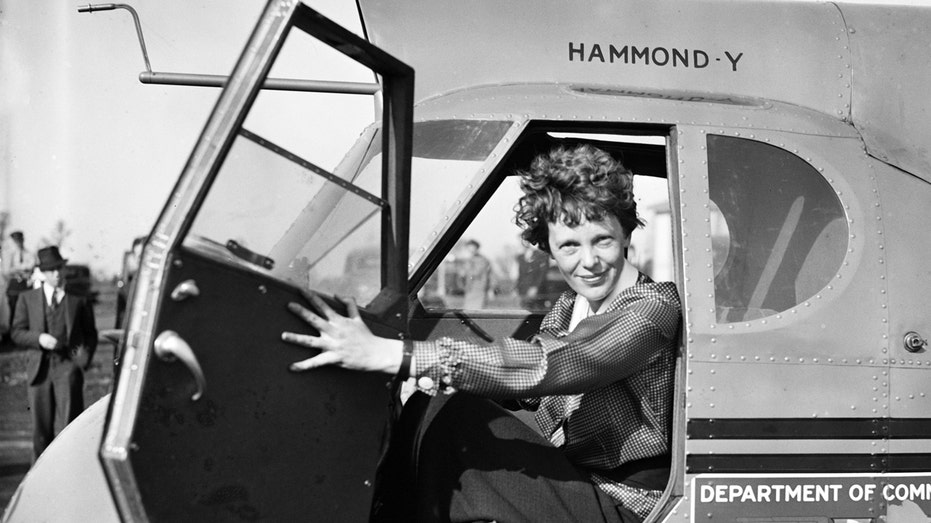
Amelia Earhart’s New Files: How a Lost Flight Became a Geopolitical Story About Power and Secrecy

Sarah Johnson
December 12, 2025
Brief
Newly released Amelia Earhart archives reveal how her 1937 disappearance became a geopolitical drama involving Japan, Roosevelt’s Navy, and contested family narratives that still shape conspiracy theories today.
Amelia Earhart’s Newly Released Files: What Fresh Documents Reveal About Power, Propaganda, and a 90-Year Mystery
The newly released 3,700 pages of National Archives records on Amelia Earhart do more than add color to a famous disappearance. They reopen a window into 1937 geopolitics, the U.S.–Japan relationship on the eve of World War II, and the way governments carefully stage-manage high-profile tragedies. Beneath the headlines about ships and search costs lies a deeper story about power, gender, and information control that still shapes how we talk about missing people and national myth-making today.
Why this release matters now
On the surface, the new documents confirm that Japan cooperated in the search for Earhart and that the U.S. government framed the expensive operation as a routine military exercise. But the real significance is threefold:
- They complicate popular conspiracy narratives that cast Japan solely as a villain while also illustrating how partial openness by governments can fuel, not quell, speculation.
- They show how the Roosevelt administration used bureaucratic language and budget rationales to justify an emotionally charged, geopolitically sensitive search in the Pacific.
- They highlight how women on the margins of official power—Eleanor Roosevelt and Amy Otis Earhart—shaped, challenged, and sometimes contradicted the official story.
The bigger picture: Earhart’s disappearance in a world on edge
To understand why these records matter, you have to put July 1937 back in its original setting.
Amelia Earhart vanished on July 2, 1937, while attempting to circumnavigate the globe. Her last known contact came as she tried to locate tiny Howland Island in the central Pacific, guided by the Coast Guard cutter Itasca. At the time:
- Japan was rapidly expanding in East Asia. It had already occupied Manchuria (1931) and was days away from full-scale war with China (the Marco Polo Bridge Incident began July 7, 1937).
- The United States was wary, but not yet at war. Washington was tracking Japan’s Pacific ambitions while trying to avoid open confrontation.
- The central Pacific was a strategic chessboard. Remote islands like Howland, Wake, and others were not just dots on Earhart’s flight plan; they were potential bases, refueling sites, and listening posts in a region both powers knew might become contested.
Against that backdrop, Earhart’s disappearance was never just a private tragedy. It was a highly public event involving U.S. Navy assets, international territory, and air routes that overlapped with military concerns. That’s why a memo between Secretary of State Cordell Hull and Japan’s Ambassador Hiroshi Saito—seemingly bureaucratic on its face—offers such a telling snapshot of how both countries wanted to be seen.
What the new documents actually add
The newly released papers underscore several key points:
1. Japan’s cooperation was real—and strategically useful
The memo describing two Japanese ships participating in the search is important because it puts concrete detail behind what had long been described in general terms. The language—Japanese officials were told to “keep closely posted on the search in the hope of being of some help”—signals several things:
- Public diplomacy: Japan had every incentive to demonstrate humanitarian concern for a globally famous American woman. It softened its image at a moment when its actions in China were already raising alarm in the West.
- Information-gathering: Monitoring U.S. search operations allowed Japan to observe American naval capabilities, routes, and communication practices in the central Pacific, an area that would become strategically crucial during World War II.
- Symbolic cooperation: For Washington, Japanese assistance provided a talking point: even in a tense environment, the two powers could cooperate on a non-military humanitarian mission.
Ironically, the very fact that Japan helped search for Earhart undermines later popular claims that Tokyo secretly captured and killed her—unless one assumes a very elaborate deception. That doesn’t categorically disprove such theories, but it pushes them further into speculative territory.
2. Roosevelt’s cost calculus: reframing a tragedy as training
The press transcript with President Franklin D. Roosevelt, in which he references a $4 million cost and frames the search as part of required Navy flight hours, reveals a careful political balancing act.
In the depths of the Great Depression, $4 million was not a trivial sum. By comparison, the average new home in the late 1930s cost under $4,000. Roosevelt’s message was crafted to preempt criticism that the government was overspending on a celebrity aviator:
- Budget neutrality: By emphasizing that planes needed flight hours regardless, Roosevelt argued that the search did not represent “additional cost” so much as a redirection of already planned training.
- Dual-use narrative: This reframing allowed the administration to present the mission as both humanitarian and militarily useful, fitting Roosevelt’s broader pattern of gradually strengthening the Navy while navigating isolationist sentiment.
- Managing expectations: Discussing costs so openly also subtly framed the search as finite—taxpayers would not support an endless hunt.
The transcript shows how early the U.S. government adopted now-familiar language about “training value” and “no extra cost” to justify high-profile operations that might otherwise be politically contentious.
3. Eleanor Roosevelt and the politics of information
Eleanor Roosevelt’s involvement in securing copies of the Itasca radio logs for pilot Paul Mantz highlights how information control functioned in the pre-digital era.
The radio logs were not just technical documentation; they were the final written record of contact with Earhart. Access to them meant the ability to construct alternative explanations of what went wrong. That the First Lady personally intervened shows:
- How deeply she was invested in women’s aviation and Earhart’s legacy. Eleanor was an open supporter of Earhart and women in flight, and saw accurate documentation as essential to serious investigation.
- The gatekeeping nature of archival records. Without high-level advocacy, crucial documents could remain effectively inaccessible to independent experts.
- An early example of transparency politics. While not framed as such, Eleanor’s effort parallels modern fights for access to government records under FOIA or open-data laws.
Mantz, a respected Hollywood and test pilot, was no conspiracy theorist; his interest underscores that technical analysis and serious aviation inquiry depended on overcoming bureaucratic opacity long before social media debates.
4. Amy Earhart’s 1949 statement: grief, geopolitics, and conspiracy
The file’s inclusion of a 1949 newspaper clipping quoting Amy Otis Earhart—claiming her daughter “died in Japan” on a “United States government mission, probably on verbal orders”—offers a rare, raw glimpse into how families can challenge official narratives.
By 1949, the U.S. had fought and won a brutal war against Japan and was now occupying and remaking the country as a Cold War ally. In that context, Amy’s insistence that Amelia died in Japan on a secret assignment was politically explosive, even if not taken seriously by officials.
Her statement illuminates several dynamics:
- Psychological closure: When there is no body, no wreckage, and no definitive evidence, alternative stories provide a form of meaning-making. A secret mission can feel more purposeful than a navigational error and fuel-starvation crash.
- Distrust of official explanations: After World War II, public awareness of government secrecy—ranging from wartime intelligence to nuclear testing—made the idea of covert missions more plausible to ordinary citizens.
- Gendered narratives of heroism: Casting Earhart as a covert agent aligns with mid-20th-century storytelling that valorized secret wartime service, especially as women’s visible roles in wartime intelligence became better known.
It’s important to stress that no credible archival evidence has surfaced to support the claim that Earhart was on an intelligence mission for Washington. But the fact that her mother’s belief is preserved in official files shows how agencies quietly track and file away dissenting narratives, even when they reject them.
Conspiracy, uncertainty, and the modern information echo chamber
Earhart’s disappearance has become a textbook case in how a lack of definitive evidence creates space for competing narratives—official accident, Japanese capture, or castaway on Nikumaroro (Gardner Island). The newly released documents do not settle this debate, but they do subtly shift its contours.
Japan’s documented cooperation undermines the simplest versions of the “captured by Japan” story, while Amy’s statement and the inclusion of that clipping in official files keep the idea alive in the historical record. Researchers’ continuing interest in Nikumaroro, including the recently delayed Purdue University expedition, reflects a preference among most scholars for explanations grounded in navigational errors, fuel limits, and known radio patterns rather than geopolitical intrigue.
Yet the pattern is familiar: partial transparency—thousands of pages, but still no smoking gun—can paradoxically deepen public suspicion. Every redaction or omission becomes, to some, evidence that the “real story” remains hidden. Earhart’s case foreshadows modern debates over missing aircraft (like MH370), classified intelligence, and the limits of declassification as a tool for restoring trust.
What’s being overlooked: The strategic Pacific and aviation policy
Most popular coverage of these documents focuses on personal details and sensational theories. Less attention is paid to what the search revealed about U.S. and Japanese strategy in the Pacific.
The Earhart search involved:
- Extensive use of long-range naval aircraft and cutters across a sparse, poorly mapped region.
- Coordination across distant outposts like Hawaii and U.S.-administered islands.
- Communications challenges that mirrored, on a smaller scale, the problems militaries would face just a few years later during World War II.
In practice, the search doubled as a live exercise in long-range coordination across the central Pacific—exactly the kind of environment where the U.S. and Japan would soon fight some of the war’s most pivotal battles (Midway, the Marshall Islands, the Gilberts). Roosevelt’s remark about the search serving as training was not just budget spin; it acknowledged the operational value of such missions.
In this sense, the Earhart search was an early, real-world test of doctrines and capabilities that would soon become central to U.S. naval aviation—something rarely highlighted in popular narratives about her disappearance.
Looking ahead: What to watch for
Several threads will determine how these documents reshape (or fail to reshape) our understanding of Earhart’s fate and legacy:
- Future archival releases: If additional State, Navy, or intelligence records emerge, they may further clarify or complicate Japan’s role and U.S. internal thinking about the search.
- Scientific investigations: New expeditions to Nikumaroro and other sites will continue to test the castaway hypothesis with sonar imaging, underwater robotics, and forensic analysis.
- Digital analysis of logs: Modern reanalysis of radio logs and navigation data using advanced modeling could refine our understanding of likely crash zones, potentially narrowing search areas.
- Public memory and myth-making: How educators, museums, and media incorporate these records will shape whether Earhart is remembered primarily as a tragic mystery, a pioneering professional, or a political symbol.
The bottom line
The newly released Amelia Earhart files don’t solve the mystery, but they do something arguably more important: they show, in vivid detail, how a single disappearance became entangled with international diplomacy, domestic politics, and the emerging machinery of modern information control.
They remind us that the stories we tell about missing people are rarely just about navigation errors or bad weather. They’re about who controls the records, which voices get preserved, and how nations use—or resist using—tragedy as an instrument of power.
In Earhart’s case, the documents reveal a triangle of influence: a cautious U.S. administration, a strategically minded Japan eager to appear humane, and women—Amelia herself, Eleanor Roosevelt, Amy Earhart—whose roles in aviation and policymaking were far more consequential than the official record once acknowledged. The mystery of where Earhart’s plane ultimately came to rest remains unsolved; the mystery of how states respond to such crises is now a little clearer.
Topics
Editor's Comments
What stands out in this document release is less what we learn about Earhart’s final hours and more what we learn about the state. The files show an apparatus already adept at converting a visceral, human loss into a managed political narrative: costs are recast as training, cooperation is highlighted even with an emerging rival, and sensitive family dissent is quietly clipped and filed. It’s tempting to dismiss Earhart conspiracy theories as fringe, but this material reminds us why they flourish—government transparency is incremental, curated, and often arrives decades too late to fully satisfy public doubts. One underexplored angle is the gendered politics of credibility: official voices were overwhelmingly male, yet two of the most influential interpretive voices—Eleanor Roosevelt and Amy Earhart—were women operating outside formal authority. Their interventions, one pushing for professional rigor and the other for a more radical alternative narrative, illustrate a tension we still see today between institutional accounts and the counter-stories advanced by those who feel excluded from the official record.
Like this article? Share it with your friends!
If you find this article interesting, feel free to share it with your friends!
Thank you for your support! Sharing is the greatest encouragement for us.