Albania’s Corruption Showdown: What Belinda Balluku’s Reinstatement Reveals About U.S. Power and State Capture

Sarah Johnson
December 13, 2025
Brief
Albania’s reinstatement of an indicted deputy PM and U.S. silence expose deeper problems: state capture, fragile reforms, and a risky Western strategy that trades real rule of law for short-term stability.
Albania’s Corruption Crisis Tests Washington’s Credibility on Rule of Law in the Balkans
The reinstatement of Albania’s deputy prime minister Belinda Balluku, despite criminal indictments and her prior removal by an Albanian court, is far more than a local corruption story. It exposes a structural tension at the heart of U.S. and EU policy in the Western Balkans: how far can Washington and Brussels tolerate entrenched corruption and “state capture” in an ally they also rely on for NATO stability, security cooperation, and migration control?
Equally telling is what the U.S. is not doing. The State Department’s refusal to comment, after years of backing judicial reforms and imposing selective sanctions on Albanian elites, raises uncomfortable questions: Is U.S. anti-corruption policy in the Balkans principled, or is it selectively deployed against those out of favor while strategic partners get a softer touch?
Albania’s Long Struggle With Corruption and “State Capture”
To understand why the Balluku case matters, it has to be placed in a longer arc of Albanian governance since the fall of communism.
Since the early 1990s, Albania has oscillated between attempts at democratic reform and recurring scandals in which political elites, business interests, and organized crime have become deeply intertwined. The collapse of nationwide pyramid schemes in 1997, which wiped out many Albanians’ savings, sparked violent unrest and left a lingering perception that economic and political institutions are easily manipulated for private gain.
Over the last decade, Prime Minister Edi Rama’s Socialist government has dominated Albania’s political landscape, winning repeated elections while being dogged by allegations of corruption, clientelism, and links to criminal networks. International watchdogs reflect this pattern:
- Transparency International has consistently placed Albania in the lower half of its Corruption Perceptions Index among European states.
- EU progress reports have repeatedly listed corruption and political influence over the judiciary as core obstacles to accession negotiations.
The creation of SPAK (the Special Anti-Corruption and Organized Crime Structure) was supposed to be a turning point. Backed heavily by the U.S. and EU, SPAK was designed as a semi-autonomous prosecutorial body capable of pursuing high-level corruption and organized crime, including within the political elite itself.
In that context, SPAK’s decision to indict Balluku for allegedly favoring one company in a major tunnel tender and violating rules in a Tirana road project is exactly the kind of high-profile case the reformers promised. Yet the swiftness with which the Constitutional Court reinstated her, pending a final decision, sends a more ambiguous message about the balance of power between politics and the judiciary.
What the Balluku Case Reveals About Power in Rama’s Albania
Balluku is not the first senior Rama ally to face scrutiny. Former deputy prime minister Arben Ahmetaj fled the country while under SPAK investigation and has accused Rama of personally directing key decisions on tenders and public assets, and of associating with mafia-linked figures. These allegations remain contested, but the pattern is important.
The sequence in Balluku’s case highlights several deeper dynamics:
- Judicial reforms are biting—but selectively blunted. SPAK’s indictments show that the institutions built with U.S. and EU support are willing to target the political elite. But the political counter‑pressure—via the Constitutional Court and public framing of the case as an attack on the executive—signals that the governing party intends to tightly manage the political fallout.
- Institutional independence is still fragile. Former ambassador Agim Nesho’s allegation that Rama is “shielding” Balluku and trying to shape a “protective precedent” is difficult to verify in full, but it aligns with a broader pattern in hybrid regimes: when anti-corruption bodies approach the ruling circle, legal and constitutional levers are mobilized to stall or dilute accountability.
- Corruption is systemic, not episodic. These are not isolated cases of rogue officials. Accusations about manipulated tenders, patronage networks, and organized crime links suggest a governance model where public procurement and infrastructure projects become core vehicles for political financing and loyalty-building.
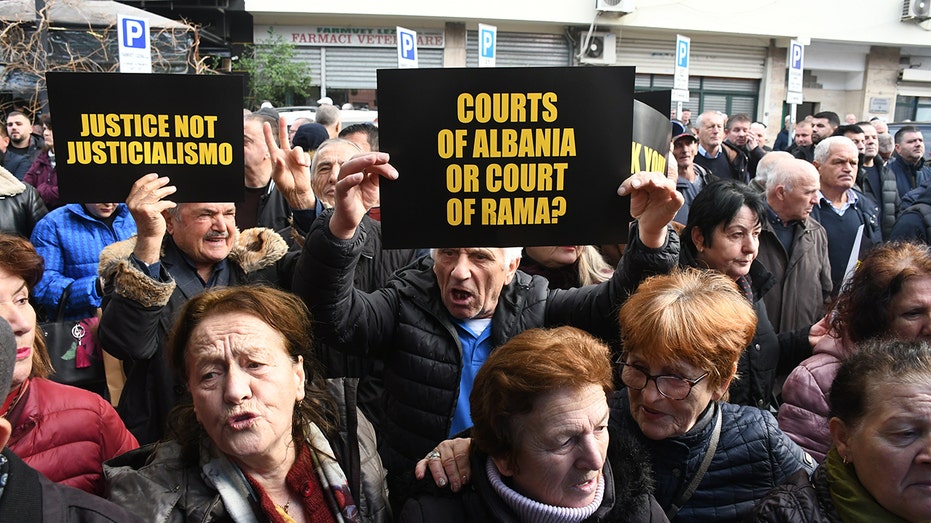
When citizens describe Rama as “Ramaduro,” likening him to Venezuela’s Nicolás Maduro, they are not simply indulging in hyperbole. They are pointing to a perception of state capture: when public institutions nominally exist, but decision-making and resource allocation primarily serve a narrow political and business elite.
Washington’s Silence: Policy Coherence or Strategic Convenience?
The U.S. has invested heavily in Albania’s justice reform, vetting judges and prosecutors, financing anti-corruption projects, and touting Albania as a partner in NATO, regional stability, and the war in Ukraine. The State Department has not hesitated to sanction certain Albanian figures, including former Prime Minister Sali Berisha in 2021, for “significant corruption.”
In that light, the refusal to comment on Balluku’s reinstatement—or on whether her visa might be affected—stands out. There are several possible explanations, each with its own implications:
- Legal caution. Officially, the United States does not comment on “ongoing legal matters.” This is a standard line. But in practice, Washington has often issued strong statements when it wanted to send a signal, even during ongoing cases.
- Strategic restraint. Albania is a NATO member bordering the Adriatic, a critical corridor for migration routes and regional security. The U.S. may fear that overt pressure on Rama’s circle could destabilize a government it sees as a reliable ally, especially at a time of heightened geopolitical competition with Russia and China in the Balkans.
- Perception of double standards. Sanctioning an opposition leader like Berisha while declining even rhetorical pressure on current officeholders fuels a narrative inside Albania that U.S. anti-corruption efforts are politically selective rather than principled.
For Washington, that perception risk is serious. It can erode the credibility of U.S. rule-of-law messaging not only in Albania but across the region, where other leaders watch closely to see which red lines the U.S. actually enforces.
The EU Accession Angle: Can a “Banana Republic” Join the Club?
Albania’s EU accession path hinges on demonstrable progress in the rule of law, judicial independence, and anti-corruption. Brussels has repeatedly stressed that reforms must not merely exist on paper but be applied “impartially and sustainably.”
Yet the current picture is contradictory:
- On paper: SPAK exists, the vetting of judges has purged parts of the old judiciary, and high officials are being indicted.
- In practice: Political interference is alleged, high-level figures are swiftly rehabilitated, and backlogs and public frustration are growing, sometimes erupting into violence.
EU diplomats will be watching the Balluku proceedings less for the final verdict than for the process: Are SPAK and the courts allowed to operate without open or subtle political pressure? Do institutions apply the law consistently, regardless of political status?
If the perception of “banana republic” governance persists—where top officials appear untouchable while lower-level actors or opposition figures bear the brunt of enforcement—Brussels will face intense internal pressure from member states skeptical of further enlargement. Albania’s credibility as a rule-of-law candidate will suffer, even if other formal criteria are met.
Organized Crime, Infrastructure, and the Risk of Deepening State–Mafia Links
One under-discussed dimension of the Balluku case is the nature of the projects at stake: major infrastructure tenders. In many countries with weak institutions, large public works are among the most lucrative channels for corruption and organized crime penetration.
Albania has long been a transit route for narcotics and other illicit flows. Various reports and investigations over the years have pointed to:
- Albanian criminal groups involved in cocaine trafficking across Europe.
- Local “businessmen” with alleged ties to drug networks winning major state contracts.
- Accusations, including those cited by Nesho, about links between politicians and international cartels such as the Sinaloa cartel. These links remain contested but are taken seriously enough to trigger U.S. sanctions on certain individuals.
When a deputy prime minister responsible for infrastructure is indicted over alleged manipulation of tenders, it is not just a corruption concern; it is a security concern. Control over construction contracts, roads, tunnels, and ports can create physical and financial infrastructure for organized crime, money laundering, and illicit trade.
What’s Being Overlooked: The Domestic Social Contract
Most international coverage focuses on geopolitical angles—NATO, Russia, EU accession. But inside Albania, the stakes are more immediate: the public’s basic trust that power can be changed and checked through democratic means.
Repeated allegations of election manipulation, “multi-billion-dollar corruption scandals,” and links with criminal groups, combined with limited consequences for top officials, are eroding citizens’ faith in the system. The result is a dangerous mix:
- Mass emigration. Albania has one of the highest emigration rates in Europe; many of its young, educated citizens leave, depriving the country of the very people needed to sustain reform.
- Normalization of cynicism. When corruption is seen as a permanent feature rather than a fixable problem, civic engagement collapses and clientelism becomes rational self-defense.
- Radicalization of opposition. When institutional channels are perceived as compromised, opposition forces may increasingly resort to street protests, boycotts, or attempts to delegitimize the entire system.
The Balluku episode, then, is not just about one official’s fate. It is about whether Albania’s citizens see any meaningful line between the anti-corruption rhetoric promoted by Western partners and the reality of how justice is applied at home.
Looking Ahead: Three Key Things to Watch
- The trajectory of the SPAK case. Does SPAK pursue the investigation to its conclusion, including any potential leads beyond Balluku herself? Are there signs of intimidation or political retaliation against prosecutors and judges?
- U.S. and EU signaling. Will Washington maintain a strict “no comment” stance, or will it eventually issue a broader statement about respect for judicial independence and equal application of the law? How do EU progress reports frame this and similar cases?
- Domestic political reaction. Do protests grow, and do they remain peaceful? Does the opposition coalesce around an institutional reform agenda, or does the crisis deepen polarization and conspiracy narratives?
The Bottom Line
Albania’s move to reinstate an indicted deputy prime minister crystallizes a larger dilemma: anti-corruption institutions exist and act, but political power still appears able to shield key figures. For the U.S., quiet diplomacy may preserve short-term stability with a strategic ally, but it risks eroding the long-term credibility of its rule-of-law agenda in the Balkans.
For Albanians, the outcome of the Balluku case will be read less as a technical legal matter and more as a test of whether justice in their country finally reaches the top—or whether the system once again protects those who sit closest to power.
Expert Perspectives
Several regional and international experts offer context that goes beyond the immediate headlines:
- Alida Vračić, a Balkans governance analyst, has long argued that Western policy in the region is trapped in a “stability first” mindset: “As long as leaders deliver on security and foreign policy alignment, their domestic governance is often treated as a secondary issue. That short-termism is now backfiring.”
- Florian Bieber, professor of Southeast European History and Politics, has described regimes like Rama’s as “stabilitocracies”—governments that promise stability and pro-Western orientation while systematically weakening democratic checks and balances at home.
- Transparency International experts note that countries stuck in this pattern often see anti-corruption institutions weaponized selectively against political opponents, while allies of the ruling party enjoy informal impunity.
Together, these perspectives suggest that the Balluku case is a litmus test not only for Albania’s institutions, but for the broader Western strategy that has quietly tolerated stabilitocracies in the Balkans for more than a decade.
Topics
Editor's Comments
What stands out in the Balluku saga is not just the alleged wrongdoing, but the choreography around it. SPAK’s indictment, the court-ordered removal, and then the swift reinstatement by the Constitutional Court form a revealing sequence: reform, backlash, recalibration. This is how hybrid regimes manage external pressure—they yield just enough to keep Western partners invested, but intervene decisively when the reach of justice threatens the core of the governing coalition. The U.S. and EU have helped build Albania’s new justice architecture, yet they remain reluctant to confront how political power is adapting and neutralizing that architecture when necessary. The uncomfortable question is whether Western policy makers are prepared to accept a permanently semi-reformed Albania—as long as it stays loyal on NATO and foreign policy—or whether they will eventually risk short-term instability to insist that the rule of law applies equally to those at the very top. Until that dilemma is resolved, cases like Balluku’s are likely to recur, each time with slightly higher stakes for both Tirana and its Western backers.
Like this article? Share it with your friends!
If you find this article interesting, feel free to share it with your friends!
Thank you for your support! Sharing is the greatest encouragement for us.