
‘We Are Russia’s Next Target’: What Mark Rutte’s Warning Really Signals for NATO

Sarah Johnson
December 12, 2025
Brief
NATO chief Mark Rutte’s stark warning that “we are Russia’s next target” signals a historic shift: from crisis management over Ukraine to pre‑war planning for direct confrontation. Here’s what’s really changing.
NATO’s New Red Line: Why Rutte Is Saying Out Loud What Many in Europe Only Whisper
NATO’s new secretary general, Mark Rutte, did something in Munich that Western leaders have largely avoided since the end of the Cold War: he said the quiet part out loud. “We are Russia’s next target,” he warned, arguing that Moscow could be ready to use force against NATO within five years and that complacency in Western capitals is now the greatest gift Vladimir Putin could receive.
Strip away the rhetoric, and Rutte’s speech signals a profound shift: NATO is moving from crisis management around Ukraine toward open preparation for a potential direct confrontation with Russia. That doesn’t mean war is inevitable; it means NATO’s political center of gravity is moving from “how do we avoid escalation?” to “how do we deter an attack we now think is plausible?”
Understanding why that’s happening, and what it means, requires going back three decades and tracing a pattern that’s easy to miss if you only follow the daily headlines.
The Long Arc: From ‘Peace Dividend’ to Pre‑War Planning
When the Berlin Wall fell in 1989—the moment Rutte deliberately evoked—Western Europe entered what many assumed would be a permanent post-war era. Defense spending plummeted. The so‑called “peace dividend” was cashed in to fund welfare states, tax cuts, and EU expansion.
- In 1990, the average NATO member spent roughly 3% of GDP on defense.
- By 2014, after years of cuts and with the Afghan mission winding down, many core European states were hovering around or below 1.2–1.3%.
- That same year, Russia had already annexed Crimea.
This divergence—Europe disarming while Russia rearmed—is the unspoken backdrop to Rutte’s urgency. Moscow spent the 2000s rebuilding its army, modernizing nuclear forces, testing cyber and hybrid tools in Estonia (2007), Georgia (2008), Ukraine (2014 onward), and Syria (2015 onward). NATO, meanwhile, spent the better part of two decades assuming large‑scale territorial war in Europe was obsolete.
Rutte’s message is not just that Russia is dangerous. It’s that NATO’s institutional baseline assumptions about the European security environment—assumptions baked into budgets, force structures, and industrial policy since the 1990s—are now dangerously outdated.
Why Talk About Being ‘Russia’s Next Target’ Now?
On the surface, the trigger is obvious: Russia’s ongoing full‑scale war against Ukraine, ramped‑up missile and drone attacks, and a series of incidents in and around NATO states—from drones violating Polish airspace to MiG‑31s crossing into Estonia and, most recently, a sabotage attack on a Polish railway line allegedly commissioned by Russian intelligence.
But there are deeper drivers behind Rutte’s decision to sharpen the rhetoric now:
- Strategic timing around Ukraine’s battlefield trajectory. If Russia consolidates gains in Ukraine or freezes the conflict on favorable terms, it can reconstitute forces and shift attention to NATO’s eastern flank. European intelligence assessments in recent months have increasingly converged on a 3–7 year window in which Russia could be ready to test NATO directly—especially if the alliance appears divided or underprepared.
- Uncertainty about U.S. reliability. References in the story to Donald Trump’s pressure on NATO spending and debate over U.S. troop levels in Europe aren’t incidental. European leaders have quietly absorbed a reality: American guarantees may still be credible today, but U.S. policy is now highly volatile from election to election. Rutte’s call for a 5% of GDP defense spending target by 2035 is, in essence, a hedge against U.S. political whiplash.
- Hybrid warfare crossing a psychological threshold. Cyberattacks, disinformation, energy blackmail, and covert sabotage were long treated as “grey zone” nuisances. The alleged Russian‑commissioned blast on a Polish railway—and the pattern of drone and airspace incursions—blur the line between harassment and attack. They’re test probes: how far can Moscow push before Article 5 solidarity fractures?
Why 5% Defense Spending Is a Political Revolution, Not a Budget Line
The commitment NATO members made in June—to move toward 5% of GDP on defense by 2035—sounds like another technocratic pledge. It isn’t. For most European societies, this is nothing less than a re‑ordering of domestic priorities and social contracts.
For context:
- For decades, NATO’s benchmark was 2% of GDP; few Europeans reached it until after 2014, and even then reluctantly.
- 5% is Cold War‑level spending. At various points in the 1980s, the U.S. hovered around 5–6%, the UK and France above 4%. Post‑2000 Europe has been nowhere near those levels.
Why does Rutte argue that this isn’t a moment for self‑congratulation? Because the key constraint is no longer political intent; it’s industrial and societal capacity.
Defense production lines that were mothballed or consolidated over decades can’t be scaled overnight. NATO states are discovering that:
- Artillery shell production, for example, has struggled to keep pace with Ukraine’s consumption rates. What was once a peacetime stockpile issue has become a structural manufacturing problem.
- Skilled labor in precision manufacturing, shipbuilding, and aerospace is scarce. Societies that oriented younger workers toward services now need welders, engineers, and machinists at scale.
That’s why Rutte’s warning that “the time for action is now” is about more than money. It’s about time lags: if NATO believes Russia could be militarily ready to confront the alliance in five years, and it takes roughly a decade to fully reconstitute heavy forces and industrial base, then 2035 may already be late.
Russia’s Playbook: From Ukraine to ‘Empire‑Building’ at NATO’s Edge
Rutte invoked Ronald Reagan’s “evil empire” language to describe Putin’s ambitions, calling him “in the empire building business again.” That’s not just rhetorical flourish. It reflects a particular reading of Russia’s recent behavior:
- Territorial revisionism. From Georgia (2008) to Crimea (2014) and the full‑scale invasion of Ukraine (2022), Moscow has repeatedly used force to redraw borders in its favor.
- Strategic messaging about NATO. Putin’s repeated claims that Russia is “ready” if Europe “wants to wage war with us” serve dual purposes: deterrence toward NATO publics and reassurance at home that Russia is not on the back foot despite severe losses in Ukraine.
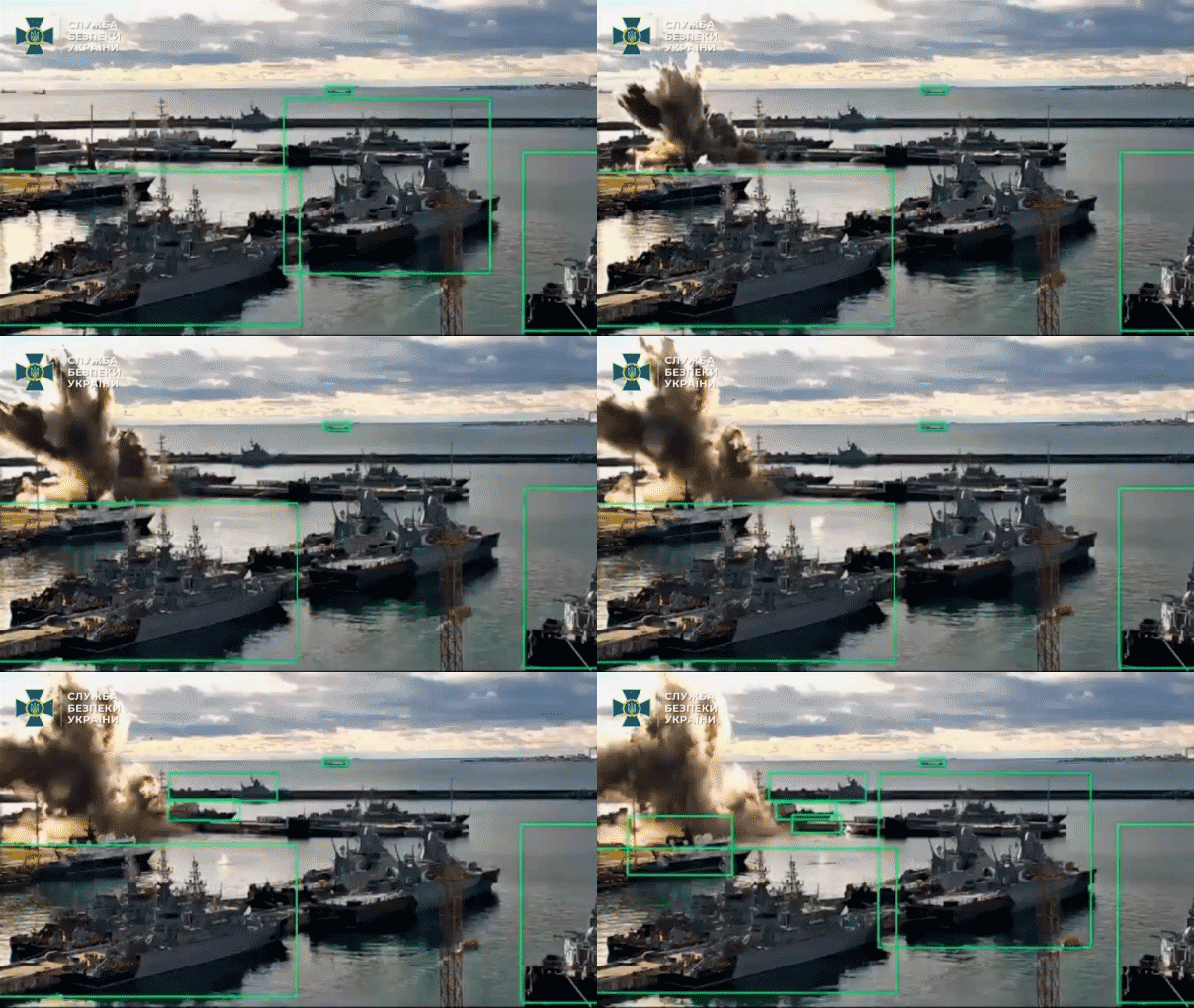
- Hybrid pressure on NATO states. The railway blast in Poland, if verified as Russian‑commissioned, would join a string of incidents—spy networks in German ports, suspected sabotage of undersea infrastructure, drone incursions—that seem designed to probe vulnerabilities while staying below the threshold of open war.
The overlooked element here is learning. Russia has observed Western reaction patterns for 15 years: loud condemnations, sanctions, limited troop deployments—but extreme caution about direct confrontation. That creates incentives to keep pushing the line without clearly crossing it.
Internal NATO Politics: Unity on Paper, Fault Lines in Practice
Rutte’s warning about “quiet complacency” isn’t aimed only at publics; it’s also directed at fellow leaders who, in private, still treat Ukraine and the eastern flank as crises to be managed away rather than structural shifts.
Three major fault lines matter here:
- East vs. West within NATO. Eastern flank states—Poland, the Baltics, the Nordics—see Russia as an immediate existential threat. Western European states like Germany, Italy, and Spain often prioritize economic stability and are wary of open‑ended military commitments. These differing risk perceptions affect everything from tank deliveries to troop deployments.
- Nuclear vs. non‑nuclear allies. NATO’s nuclear powers (U.S., UK, France) can credibly threaten escalation; smaller states rely entirely on that umbrella. Russia’s frequent nuclear signaling is intended to stress test those guarantees.
- Domestic political cycles. Every European election now doubles as a referendum on how much pain voters are willing to absorb—higher energy prices, larger defense budgets, fewer social benefits—in the name of long‑term security.
That’s why Rutte’s framing of defense spending as “defending our way of life” matters. He’s trying to recast defense not as a technocratic issue, but as a core component of welfare, freedom, and sovereignty itself.
What a Russia–NATO Confrontation Would Actually Look Like
Most discussion of “Russia attacking NATO within five years” conjures images of tank columns heading for the Baltic states. While that scenario can’t be ruled out, the more plausible—and more destabilizing—path involves an escalatory ladder of hybrid and limited military actions.
Possible pathways, based on current trends and expert assessments, include:
- Intensified sabotage and covert attacks on critical infrastructure—railways, energy grids, ports—across Eastern and Central Europe, designed to disrupt logistics and undermine NATO’s confidence in its rear areas.
- Persistent air and maritime incidents in the Baltic and Black Seas, including drone swarms, GPS spoofing, and risky intercepts that increase the odds of an accident spiraling into crisis.
- Weaponized migration and political disruption, using Belarus and other intermediaries to create domestic turmoil in vulnerable states, coupled with disinformation campaigns ahead of key elections.
- Limited territorial feints, such as “protective” operations near Russian‑speaking populations in the Baltics, framed as humanitarian or defensive, testing whether NATO will mobilize fully for what Moscow presents as a localized dispute.
The core risk isn’t that NATO would immediately collapse. It’s that repeated, ambiguous incidents erode political unity and delay decision‑making at precisely the moment Moscow is testing whether Article 5 is psychologically, not just legally, credible.
What Most Coverage Misses: The Industrial and Democratic Stress Test
Much mainstream reporting focuses on military maneuvers and rhetorical exchanges. Less examined are the two arenas where this emerging confrontation will actually be decided: defense industrial capacity and democratic resilience.
On the industrial side, the question is whether Europe can translate pledges into hardware at scale—and do so sustainably. That means:
- Long‑term contracts that convince defense firms to invest in new facilities, not just take one‑off orders.
- Cross‑border industrial integration to avoid duplication and maximize economies of scale.
- Balancing export controls with the need to supply Ukraine and replenish NATO stocks.
On the democratic side, the pressure point is public patience. A protracted confrontation with Russia will test:
- Whether European voters will accept higher defense spending at the expense of social programs.
- How resilient societies are to sophisticated disinformation, including narratives that blame NATO for “provoking” conflict.
- Whether political extremes—on both left and right—can capitalize on war fatigue to fracture coalition governments.
Rutte’s warning about complacency is, in many ways, a warning about democracy’s tendency to under‑invest in long‑term security when short‑term comfort feels more urgent.
Looking Ahead: What to Watch in the Next 3–5 Years
Several markers will reveal whether Rutte’s call is being translated into real change:
- Actual defense budgets vs. headline pledges. Are countries writing multi‑year plans that reach toward 3–4% by 2030, or are they keeping most increases on paper?
- Force posture on the eastern flank. Do temporary rotations of NATO forces become permanent, brigade‑level deployments in Poland, the Baltics, and Romania?
- Ukraine’s battlefield status. If Ukraine is pushed into a bad peace or frozen conflict under duress, the risk calculus for Russia’s next moves toward NATO territory shifts significantly.
- U.S. political outcomes. U.S. elections will shape European assumptions about the reliability of American nuclear and conventional guarantees. A perception of U.S. retrenchment will accelerate European rearmament—but could also embolden Moscow in the short term.
Ultimately, the question isn’t just whether Russia will be ready to confront NATO in five years. It’s whether NATO societies will have rebuilt enough military, industrial, and political resilience to make such a confrontation clearly unwinnable for Moscow—and therefore unlikely to be attempted.
The Bottom Line
By telling NATO allies “we are Russia’s next target,” Mark Rutte is not predicting an inevitable war. He is forcing a political reckoning: either Europe treats the current period as a pre‑war era in which deterrence must be rebuilt at speed, or it continues to drift, hoping that geography, history, and American power will keep it safe.
History suggests hope is a poor strategy. The real test, now, is whether NATO can convert fear into long‑term discipline—on budgets, on industrial policy, and on political unity—before Moscow’s next move makes today’s warnings look understated.
Topics
Editor's Comments
What stands out in Rutte’s warning is not only the sharper language about Russia, but the implicit admission that NATO’s own strategic culture has lagged behind reality. For years, European leaders tried to square the circle: acknowledging Russia as a threat while maintaining peacetime defense structures and welfare-state politics largely unchanged. That compromise is breaking down. Yet there’s a tension that hasn’t been fully confronted: rebuilding deterrence at Cold War-like levels in societies that are far more skeptical of military power, fragmented by social media, and under demographic and fiscal strain. The risk is that governments overpromise on rearmament without building durable domestic consensus, leading to boom-and-bust cycles in defense spending that actually weaken credibility. A more honest debate would ask voters directly: what are we willing to trade—financially and politically—for security, and for how long? Absent that, Rutte’s call to arms could become just another moment of alarm that fades when budgets tighten and headlines move on.
Like this article? Share it with your friends!
If you find this article interesting, feel free to share it with your friends!
Thank you for your support! Sharing is the greatest encouragement for us.