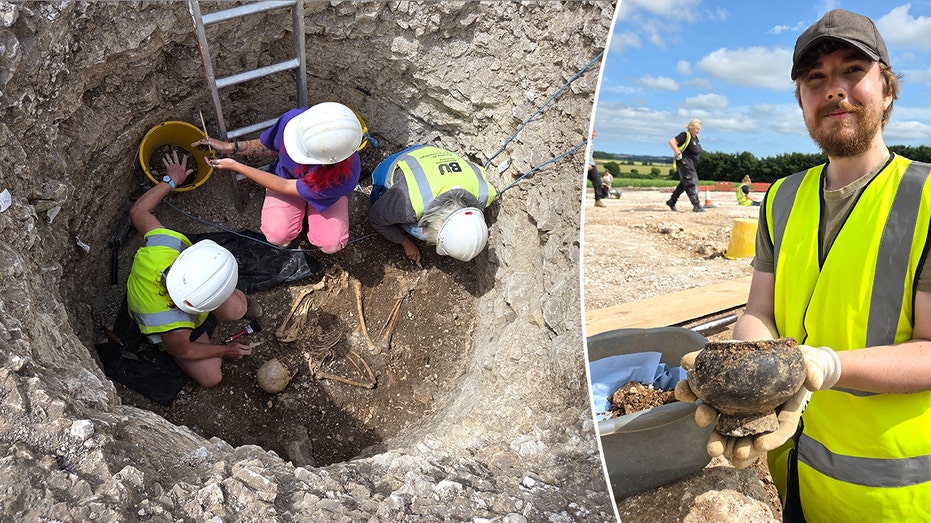
Unearthing Brutal Realities: The 2,000-Year-Old Iron Age Sacrifice That Challenges Our View of Ancient Britain

Sarah Johnson
December 3, 2025
Brief
An Iron Age British burial revealing ritual sacrifice uncovers social hierarchies and violence in pre-Roman Britain, challenging peaceful tribal narratives with new archaeological evidence.
Opening Analysis
The recent discovery of a 2,000-year-old murder victim in an Iron Age British settlement offers a rare and profound glimpse into the darker undercurrents of pre-Roman society. This finding not only disrupts romanticized notions of ancient tribal life but also challenges long-held assumptions about social stratification, ritual practices, and the lived realities of marginalized individuals in Iron Age Britain. Unearthed during filming of a televised archaeology series, the skeleton’s unique burial context raises complex questions about status, violence, and the intersection of ritual and social control on the eve of Roman conquest.
The Bigger Picture
The archaeological site belongs to the Durotriges tribe, one of several Iron Age tribes inhabiting Southwest Britain before and during the early phases of Roman expansion circa the 1st century BCE and CE. The Durotriges are known for their sophisticated hillforts and material culture, reflecting a structured society with defined social roles. Their settlements, sometimes fortified, suggest a community reliant on agriculture, animal husbandry, and localized trade.
Traditionally, Iron Age Britain has been envisioned through a lens that emphasizes communal tribal unity and ritualized burial customs characterized by careful placement and grave goods. Previous archaeological work in the region has largely emphasized the artistry and daily life of elite members—warriors, chieftains, and craftsmen. Yet burial practices varied widely, and there is mounting evidence that lower-status individuals, prisoners, enslaved people, or victims of human sacrifice experienced markedly different, often violent, ends.
The Roman literary sources have long portrayed pre-Roman Britons as practicing human sacrifice, but archaeological corroboration has been sporadic and often controversial. This successive discovery provides physical evidence supporting those accounts, enriching a narrative that must grapple with brutality alongside cultural complexity.
What This Really Means
The teenage girl’s burial face-down in a pit without grave goods, in stark contrast to the formal graves around her, implies social marginalization—likely she was at the bottom of the social hierarchy, possibly a captive or enslaved person. The forensic evidence of hard manual labor aligns with this interpretation, suggesting systemic oppression or coerced labor existed in Iron Age society.
Moreover, the unhealed wrist fracture and indication of tied wrists suggest resistance and forced submission, marking the burial as more than a simple death: it was a deliberate execution, possibly ritualized human sacrifice. Such practices could have served several social functions, including appeasing deities, reinforcing elite power through display of control over life and death, or purging perceived threats and outsiders. This challenges any notion of uniformly peaceful tribal existence and demands reconsideration of the sociopolitical dynamics on the cusp of Roman conquest.
Importantly, this discovery also humanizes those who are often absent in archaeological narratives—the socially disenfranchised, the enslaved, the victims of violence—giving them a voice through careful scientific inquiry. It reveals the duality of Iron Age society, capable of cultural sophistication and artistry on one hand and stark social inequalities and violence on the other.
Expert Perspectives
Miles Russell, the excavation leader, emphasizes that such findings confirm Roman accounts of widespread human sacrifice and provide tangible proof of the experiences of lower-status individuals. His call to "give back their voice" highlights a growing movement within archaeology towards inclusive narratives that acknowledge social complexity and darker realities.
Dr. Jane Evans, a bioarchaeologist specializing in Iron Age Britain, notes that skeletal evidence like muscle attachment patterns and trauma can illuminate daily life and social structures, revealing inequities invisible in material artifacts alone.
Professor Barry Cunliffe, a leading authority on Iron Age Europe, adds, "This case compels us to rethink the role of ritual violence as a social mechanism—a means of enforcing power, identity, and control." He stresses that human sacrifice may have been both a spiritual act and a political tool within tribal communities agonizing over internal cohesion and external threats.
Data & Evidence
- The girl was buried face-down, tangled and without typical grave goods like pots or brooches, contrasting with many formal burials at the site.
- Skeletal analysis shows muscle attachments consistent with heavy labor, suggesting lower social status.
- An unhealed wrist fracture and indications of tied wrists imply a violent death, likely intentional execution or sacrifice.
- Comparable finds from other Iron Age sites reveal similar pit burials correlated with social marginalization, suggesting a broader pattern.
- Roman descriptions—though often biased—mention human sacrifice as a common practice in pre-Roman Britain, a claim now partially validated by archaeological evidence.
Looking Ahead
This discovery sets the stage for more nuanced investigation into Iron Age social hierarchies, including the roles of captives, enslaved people, and human sacrifice within these communities. Further multidisciplinary studies integrating archaeology, osteology, and isotope analysis could clarify geographic origins of victims, dietary differences, and connections to conflict or trade.
Moreover, as public interest in archaeology grows through media engagement—illustrated by the serendipitous filming context—there is a unique opportunity to educate broader audiences about the complex realities of ancient societies beyond idealized narratives.
Finally, this raises broader questions about how societies memorialize marginalized individuals, which resonates with contemporary debates over whose histories get told. Preserving and interpreting such discoveries responsibly will influence both academic discourse and public memory.
The Bottom Line
The unexpected uncovering of a 2,000-year-old possible human sacrifice victim at a Dorset Iron Age site shattered peaceful preconceptions, illuminating the brutal social realities and power structures in pre-Roman Britain. This case enriches archaeological discourse by centering marginalized individuals, confirming ancient accounts of ritual violence, and prompting deeper inquiry into the complex fabric of ancient tribal life.
Topics
Editor's Comments
This discovery offers a sobering reflection on the complexities of ancient societies often lost in the celebration of cultural achievements. It underscores the importance of uncovering voices of those on the margins—victims, captives, slaves—whose experiences are essential for a full, honest archaeological narrative. It also opens avenues to interrogate how ritual violence functioned as a means of social regulation rather than merely a spiritual practice. As further analysis unfolds, we must critically consider how these findings reshape both academic narratives and public perceptions of Britain’s distant past.
Like this article? Share it with your friends!
If you find this article interesting, feel free to share it with your friends!
Thank you for your support! Sharing is the greatest encouragement for us.