Jasmine Crockett, Supreme Court Ethics, and the Next Phase of America’s Power Struggle

Sarah Johnson
December 12, 2025
Brief
Jasmine Crockett’s call for Supreme Court ethics rules is really about shifting power between Congress and the Court. Here’s how it fits into a decades-long legitimacy crisis and institutional arms race.
Jasmine Crockett’s Supreme Court Broadside Is Really About Power, Not Just Ethics
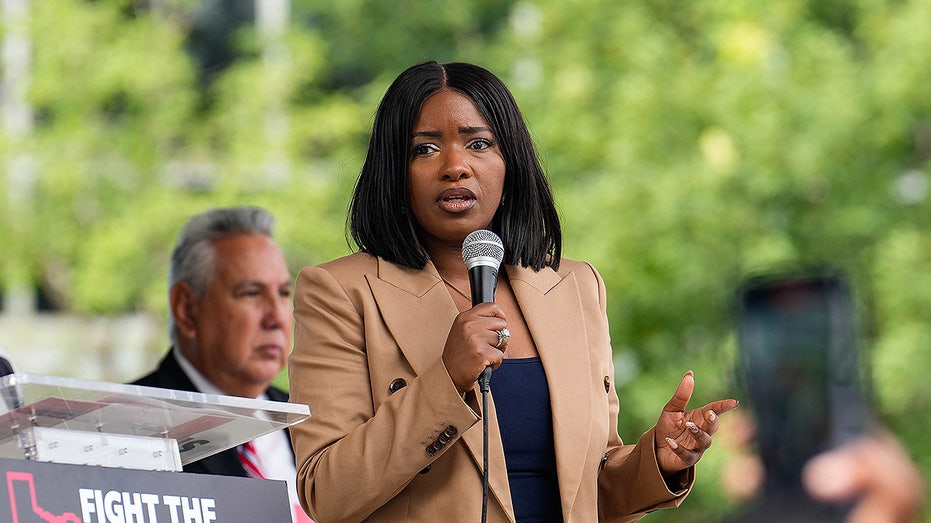
Rep. Jasmine Crockett’s call for the Senate to impose “ethical guidelines” on the Supreme Court is being framed as a progressive broadside against a conservative court. But beneath the partisan noise is a deeper story about a 50‑year struggle over who really governs the country: elected legislators, or life-tenured judges.
Her comments land at the intersection of three major fault lines in American politics: the legitimacy crisis facing the Supreme Court, the hardening of constitutional hardball in Congress, and the Democratic Party’s recalculation about how aggressive it’s willing to be with institutional power. What looks like a campaign talking point is, in fact, a preview of the next phase of the war over the Court.
The bigger picture: How the Supreme Court became the central battlefield
To understand why a first-term House member running for Senate is talking about Supreme Court ethics, you have to zoom out half a century.
- Post–Warren Court backlash (1970s–1990s): After the Warren and Burger Courts handed down landmark decisions on school desegregation, abortion, criminal procedure, and voting rights, conservatives built an intellectual and political movement to recapture the judiciary. The Federalist Society (founded 1982) became the talent pipeline; judicial nominations became culture-war flashpoints.
- The polarization of confirmations: Robert Bork’s failed nomination in 1987, the Clarence Thomas hearings in 1991, and the razor-thin, party-line votes for recent justices marked a shift from broad, bipartisan deference to open ideological warfare. The Court’s composition is now treated as a prize of partisan control.
- Norm-breaking in recent decades: The refusal to consider Merrick Garland in 2016 and the rush to confirm Amy Coney Barrett in 2020 signaled that Senate norms around the Court had largely collapsed, even if the constitutional rules remained intact.
- Recent decisions as accelerant: Rulings like Dobbs (overturning Roe v. Wade), Bruen (expanding gun rights), and major moves on voting rights, environmental regulation, and executive power have convinced many Democrats that the Court is not just conservative, but structurally out of step with national majorities.
Layer on top of this the ethics controversies involving Justices Clarence Thomas and Samuel Alito — undisclosed luxury travel, benefactors with business before the Court, political symbolism displayed at private homes — and you get a perfect storm: a powerful, deeply consequential Court whose public approval is sliding and whose internal policing appears thin.
That’s the environment in which Crockett is speaking. She’s not just talking about ethics; she’s talking about how, and by whom, the Court will be constrained.
What Crockett is really arguing — and what’s constitutionally at stake
Crockett makes three distinct claims, some explicit, some implicit:
- The Senate is the only body with oversight of the Supreme Court.
- The justices “do not have any ethical guidelines.”
- Ethics oversight is part of a broader toolkit: confirmation leverage, court expansion, and accountability for “bad actors.”
Each contains a kernel of truth, a layer of political framing, and a set of serious constitutional questions.
1. Is the Senate really the only oversight body?
The Constitution doesn’t give any branch sweeping authority to “oversee” the Supreme Court in a modern compliance sense. But:
- The Senate confirms justices, can hold oversight hearings, and — together with the House — holds impeachment power.
- Congress as a whole can regulate aspects of the Court’s jurisdiction and structure (including the number of justices) under Article III, and can set certain ethics and disclosure requirements.
- The Court itself has historically claimed primary responsibility for its internal ethics and discipline, including through its self-adopted Code of Conduct (only formally codified for the first time in November 2023).
So when Crockett says the Senate is the “only body” with oversight, she’s engaging in rhetorical emphasis more than precise constitutional description. But the underlying power dynamic she’s highlighting is real: without Senate cooperation, presidents cannot reshape the Court, and without congressional action, ethics enforcement remains largely voluntary.
2. Do justices really lack ethics rules?
Federal judges at the lower levels have long been bound by the Code of Conduct for United States Judges, which includes recusal standards and restrictions on outside activity. For decades, that code did not formally bind Supreme Court justices, who only recently adopted their own version.
Critically, however:
- The Court’s new code lacks an independent enforcement mechanism.
- Recusal decisions remain entirely up to the individual justice.
- There is no external review body, no inspector general, and no clear sanctions process short of impeachment.
That’s the vacuum Crockett is pointing to: not the absolute absence of written rules, but the absence of enforceable ones.
3. Ethics as entry point to something bigger: court expansion and constitutional hardball
Crockett explicitly links ethics to the threat of court expansion and to using Senate power to create “accountability.” This is part of a broader trend known as constitutional hardball: using lawful but previously taboo maneuvers to gain institutional advantage.
- On the right, blocking Garland, rapidly confirming Barrett, and using bare majority power to reshape the courts were all versions of this strategy.
- On the left, proposals to expand the Court, term-limit justices, strip jurisdiction in certain areas, or require enforceable ethics oversight can be understood as a response in kind.
Crockett’s message to Democratic voters is that she’s willing to play hardball too — that ethics rules are not just about good government but about shifting the balance of power away from what many Democrats see as an entrenched, unaccountable conservative supermajority on the Court.
Why this is surfacing in a Texas Senate race
On paper, Texas is hostile terrain for a candidate closely identified with the progressive wing of the party. Moderate strategists routinely argue that Democrats must run centrist, business-friendly candidates to be competitive statewide.
Crockett is betting on a different theory of the case:
- Nationalization of state races: In an era where voters consume politics through national media and social platforms, Senate races increasingly resemble national referendums on Trump, abortion, and the Supreme Court rather than local issues. Talking about the Court keeps her in that national conversation.
- Mobilization over persuasion: Instead of chasing swing voters, Crockett appears focused on energizing younger, more diverse, and more progressive voters who are deeply alienated by the Court’s recent decisions, especially on abortion and voting rights.
- Institutional stakes as campaign frame: Her argument that flipping the House is insufficient without the Senate is essentially a civics lesson packaged as a campaign pitch: if you want Supreme Court accountability, you must win the chamber that confirms justices and can write ethics laws.
In that sense, talking about Supreme Court ethics is not a niche legal issue — it’s a way to translate abstract institutional power into a concrete electoral stakes message: vote for me if you want to rein in this Court.
Expert perspectives: Ethics, separation of powers, and the risk of escalation
Legal and political scholars have been warning for years that the United States is drifting toward a cycle of tit-for-tat institutional escalation. Crockett’s comments should be read through that lens.
Constitutional law scholar Laurence Tribe has argued that Congress has clear authority to impose certain ethics and transparency requirements on the Court, particularly regarding financial disclosures and recusal standards. But he has also cautioned that “radical” structural changes, like court-packing, risk turning the Court into an openly partisan arm of whichever party last controlled Congress.
On the other side, conservative legal thinkers such as Ed Whelan have framed the ethics debate as a political vehicle to delegitimize rulings progressives don’t like, warning that aggressive congressional moves could undermine judicial independence and invite retaliation when power shifts.
Public opinion data adds another dimension. Recent polling by Gallup and other firms has shown Supreme Court approval ratings dropping to near-record lows, often in the 40% range or below, with particularly sharp declines among Democrats. At the same time, large majorities — often 70% or more in various surveys — say they support binding ethics rules for justices.
That combination — low trust in the institution but high bipartisan support for ethics reform — is the opening Crockett is trying to exploit.
What mainstream coverage often misses
Most reporting on Crockett’s remarks will focus on the horse race: is she too liberal for Texas, is this smart politics, will it hurt or help in November? That frame misses several deeper dynamics.
- This is part of a long-term Democratic shift on institutional power. For years, Democrats emphasized norms and restraint while Republicans focused on court-building. Post-Dobbs, progressive voters are increasingly demanding that their leaders treat institutions as arenas for power contestation, not sacrosanct neutral bodies.
- Ethics is a proxy for legitimacy. Imposing enforceable ethics rules is not just about preventing gifts or trips; it’s about signaling that the Court is subject to the rule of law like every other branch. Refusal to act feeds perceptions that the Court sits above the system it interprets.
- Republicans face a mirror-image trap. They benefit from the Court’s current ideological lean, but defending it too aggressively against any ethics oversight risks alienating voters who may be conservative but still want basic accountability and transparency.
- Once ethics become partisan, every decision gets a cloud. If each controversial ruling is followed by dueling accusations about undisclosed ties and conflicts, the Court’s authority to settle disputes could erode, pushing more conflicts back into raw politics — and onto the streets.
Looking ahead: What to watch beyond Crockett’s race
Regardless of whether Jasmine Crockett wins a Senate seat, the fault lines she’s highlighting are not going away. Three developments are worth watching closely:
- Substantive ethics legislation: Will a future Congress seriously move on bills that require enforceable recusal standards, independent ethics review, or stricter disclosure for justices? Some proposals already exist, but leadership has been reluctant to force a showdown with the Court.
- Soft versus hard constraints: There’s a big difference between conditioning confirmations on informal ethics commitments, and formally restructuring the Court or stripping its jurisdiction. The first is likely; the second would be a genuine constitutional rupture.
- Voter reactions to “court as ballot issue” politics: If more candidates run on explicitly reshaping or constraining the Court, we’ll learn whether Supreme Court legitimacy has become a kitchen-table issue or remains a concern mainly for activists and elites.
In the background is a harder question: what happens if both parties come to see the Court primarily as a prize to be seized and remade whenever they hold power? That path leads away from judicial independence and toward a more openly parliamentary, winner-take-all model — without the guardrails most parliamentary systems build in.
The bottom line
Jasmine Crockett’s demand that the Senate impose ethical guidelines on the Supreme Court is less about rhetorical outrage and more about rebalancing power among branches of government. It reflects a Democratic base newly energized — and enraged — by the Court’s direction, and a political class increasingly willing to treat institutional design as a live battlefield rather than a settled background.
Whether that produces thoughtful, narrowly tailored ethics reforms or a spiraling constitutional arms race will depend not just on Crockett or her opponents, but on whether voters reward politicians who treat the Court as an institution to be strengthened — or simply as another weapon to be captured.
Topics
Editor's Comments
What’s striking about Jasmine Crockett’s intervention is not the substance of her ethics critique—similar concerns have been raised by legal scholars across the spectrum—but the way she’s turning a structural problem into a campaign identity. This is a sign that the judiciary is no longer treated as a background institution; it’s now a frontline political issue akin to health care or immigration. That shift has upside and downside. On one hand, a Court that wields enormous power over everyday life arguably should not sit outside democratic scrutiny. On the other hand, once candidates begin promising specific institutional outcomes—more justices, different rulings, implicit litmus tests—the Court risks becoming just another branch of electoral politics. The question I’m left with is whether there’s any appetite, on either side, for reforms that enhance accountability without accelerating the arms race. Ethics rules with credible but restrained enforcement could be that middle path, yet both parties increasingly talk as if only maximalist moves will satisfy their base. The danger is that by the time we realize the value of a Court that’s seen as above the fray, it may already be too late to recover it.
Like this article? Share it with your friends!
If you find this article interesting, feel free to share it with your friends!
Thank you for your support! Sharing is the greatest encouragement for us.