
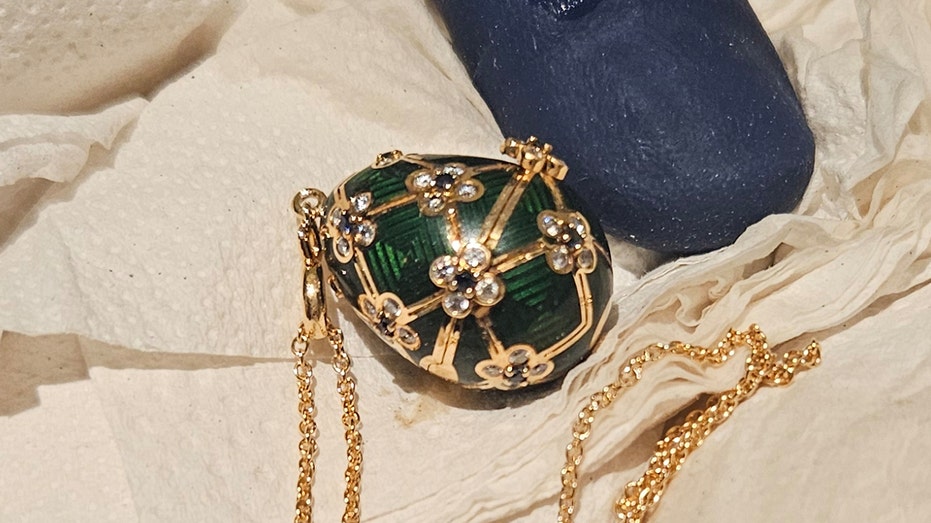
Beyond the Fabergé Egg: What a Bizarre Theft Reveals About Policing, Inequality, and Luxury Crime

Sarah Johnson
December 8, 2025
Brief
A man swallowing a $19K Fabergé pendant in New Zealand sounds bizarre, but it exposes deeper tensions around policing priorities, bodily autonomy, luxury crime, and growing economic inequality.
What a Swallowed Fabergé Egg Reveals About Modern Policing, Inequality, and the Luxury Crime Economy
A man swallowing a $19,000 Fabergé pendant in a New Zealand jewelry store sounds like a bizarre crime-of-the-week story. But beneath the comic-book visuals of officers watching a suspect for six days, waiting for a luxury object to re-emerge, is a revealing case study in how modern law enforcement treats property versus people, how the global luxury economy reshapes crime, and how risk is distributed in societies with growing inequality.
The bigger picture: When a single pendant is worth more than annual wages
The central fact here isn’t just that the pendant is rare or modeled on a James Bond Fabergé egg. It’s that a single object worn on a chain costs roughly what a full-time worker on New Zealand’s minimum wage earns in an entire year.
New Zealand’s minimum wage is NZ$23.15 per hour (2024), which works out to around NZ$48,000 before tax for a full-time worker. At current exchange rates, that’s in the same ballpark as US$19,000. In other words, this pendant is not just luxury; it is a condensed unit of labor, status, and inequality.
High-end jewelry theft has historically followed wealth: from Europe’s aristocratic households in the 19th century to Hollywood mansions, to today’s global luxury brands in malls and city centers. But what’s changed in recent decades is how liquid and internationally tradable these goods have become. Branded, limited-edition items – like a Bond-themed Fabergé egg – act almost like portable financial assets:
- Their scarcity and branding are easy to verify.
- They can be fenced or traded across borders quickly.
- They may be harder to trace than digital assets and harder to lock down than cash.
That makes them highly attractive targets in what criminologists increasingly call the “luxury crime economy” – a market where goods are not just stolen to sell, but sometimes used as informal collateral in illicit networks or even status symbols inside criminal subcultures.
Why the police waited six days: Duty of care, risk management, and optics
At first glance, it’s tempting to mock the idea of officers watching around the clock for six days while waiting for a suspect to pass an item. But from a policing perspective, the decision sits at the nexus of three pressures: legal duty of care, medical risk, and the value of the property involved.
Most modern police forces operate under a clear duty of care for anyone in custody. That means that once they know a person has swallowed a non-food, non-medical object – especially one with sharp edges or heavy metal content – they are legally and ethically obliged to ensure the person doesn’t suffer internal damage, obstruction, or poisoning. A failure to do so can (and often does) result in lawsuits, inquests, and public inquiries.
So why not surgery? Here, risk management takes over. Surgery is invasive and carries its own risks. If medical professionals judge that an object can likely pass naturally without causing harm, surgery may be considered disproportionate – especially when the driving motive would be property recovery rather than life-saving care. That’s a line no public health authority wants to cross.
There’s a second dimension: optics. A police force authorizing surgery primarily to recover a luxury pendant could be accused of valuing property over bodily autonomy. Waiting, monitoring, and documenting everything allows the state to say: we protected the suspect’s health and recovered the evidence, without crossing into ethically dubious territory.
Body as evidence container: The legal and ethical frontier
This case sits within a long, uncomfortable history of the criminal justice system treating human bodies as repositories of evidence. From forced stomach-pumping in drug cases in the 1960s and 1970s, to modern debates about cavity searches and digital extraction from phones, the central tension is: how far can the state go into – or inside – a person in the name of law enforcement?
New Zealand, like many democracies, tries to balance this through proportionality: the more intrusive the intervention, the stronger the justification needed. That’s why continuous observation, however humiliating, is often chosen over invasive procedures when objects are swallowed.
There is also the question of consent. Even if a suspect “agrees” to a medical procedure, courts may later scrutinize whether that consent was freely given or effectively coerced by the circumstances of detention. By waiting, the police sidestep that entire legal minefield.
But the case also exposes the asymmetry: if a person swallowed something dangerous to others – say, a weapon part or toxic substance – authorities might feel compelled to push for medical intervention more aggressively. When it’s an expensive pendant, there’s room to wait. That tells us something about how law enforcement prioritizes risk: immediate public safety at the top, bodily autonomy and property concerns negotiated underneath.
Luxury, spectacle, and the James Bond factor
The pendant’s connection to the James Bond film “Octopussy” is not just a quirky detail; it’s central to why this story went viral. Bond films glamorize high-stakes heists and super-elite objects – Fabergé eggs, nuclear codes, priceless art – as symbols of power and intrigue. Here, that same aesthetic crashes into a small, very human scene: a suspect, a toilet, a police guard, and six days of waiting.
Criminologists often note that media saturation around luxury crime changes both how these crimes are committed and how they’re perceived. Thieves sometimes emulate what they see on screen. But audiences also process these events as a kind of dark entertainment: the “Bond egg” that ends up in a holding cell rather than a Swiss vault.
What gets lost in the spectacle is the underlying question: why are so many cities now filled with objects that are simultaneously everyday retail items and extremely high-value financial assets? When a shopping district window contains what amounts to life-changing sums for many citizens, the line between temptation and opportunity narrows.
Who is protected, and at what cost?
This case also highlights a recurrent tension in policing priorities: the extraordinary mobilization of effort to protect property held by the wealthy versus the often slower, less visible response to crimes against marginalized people.
New Zealand, to its credit, has comparatively high trust in its police and a strong record on community policing. Yet the optics of officers providing 24/7 monitoring to safeguard a luxury pendant can still spark uncomfortable questions:
- Would the same resources be deployed for the theft of a low-value item essential to a poor person’s survival, such as a stolen mobility scooter or work tools?
- Does the market value of property effectively ration public resources, even if indirectly?
- How do such cases shape public perceptions of whose losses matter?
These questions are sharpened by broader trends. Across OECD countries, police forces face budget pressures, rising expectations around mental health and domestic violence response, and increasing workloads tied to cybercrime. In that context, a six-day surveillance operation for a single object is not trivial; it’s a choice about where time and attention go.
Expert perspectives: Crime, risk, and symbolism
Criminologists and legal scholars see this case as a convergence of three currents: symbolic crime, risk-averse policing, and the commodification of status.
Professor Michael Tonry, a leading criminologist whose work often explores proportionality in criminal justice, has argued that modern systems frequently respond more to public symbolism than to harm. A Fabergé pendant, with its Bond-movie aura and six-figure equivalent in local currency, becomes a symbol of order under threat – and symbols tend to attract disproportionate responses.
Legal scholars, meanwhile, point to the creeping expansion of what counts as legitimate bodily intrusion in the name of law enforcement. We have normalized DNA swabs, breath tests, blood tests, and sometimes even compelled decryption of devices. Continuous observation of bodily functions fits this trajectory, even if it is less physically invasive.
From a sociological perspective, the case also illustrates what French sociologist Jean Baudrillard once described as the “hyperreality” of luxury goods: objects whose value is more about story, brand, and fantasy than utility or materials. A green-enamel egg with diamonds and an octopus inside is, in practical terms, useless. Its worth lies in a narrative – Bond, exclusivity, scarcity. Yet that narrative is powerful enough to mobilize the coercive apparatus of the state to track and recover it from inside a human body.
Data and trends: Luxury theft in a shifting economy
While comprehensive global data on high-end jewelry theft is patchy, several trends stand out:
- Insurance data from major markets consistently shows spikes in luxury theft during economic downturns and cost-of-living crises.
- Organized groups increasingly target small, high-value items that are easy to move: watches, jewelry, designer handbags, and compact electronics.
- Social media and online resale platforms have made it easier to fence or resell luxury goods across borders, often faster than traditional policing can track.
New Zealand is not immune to these global dynamics, even if its overall crime rates remain lower than many countries. Placing a limited-edition $19,000 pendant in a public-facing store window effectively inserts a global luxury asset into a local urban environment – and relies on local policing to manage the risks that come with it.
Looking ahead: What this case signals for policy and policing
Though the facts of this incident are resolved – the pendant recovered, the suspect awaiting court – the underlying issues are not. There are at least four areas to watch:
- Guidelines on swallowed evidence. Expect quiet conversations within police and medical circles about clearer protocols for swallowed property, especially high-value items. Where is the line between acceptable observation and unacceptable intrusion?
- Insurance and security expectations on retailers. Luxury retailers may be pushed to invest more in preventative security (smart cases, alarms, private guards) as insurers and police question how far public resources should stretch to protect high-value stock.
- Public debate on policing priorities. Cases like this often become touchstones in discussions about whether police are doing “the right things” with their time – especially if citizens feel their own victimization is not handled with similar intensity.
- Legal tests of bodily autonomy versus evidence gathering. Future cases may force courts to grapple more explicitly with what the state can and cannot compel when evidence is literally inside a person.
The bottom line
This is not just a story about a man who swallowed a Fabergé pendant. It is a story about how modern societies have normalized objects so valuable that they can justify days of surveillance and medical risk, how policing is increasingly about managing risk around property as much as protecting people, and how our legal systems continue to wrestle with the question of how deeply the state can reach into the human body in the name of justice.
Strip away the Bond glamour and the oddity of a six-day wait, and what’s left is a quieter, more unsettling reality: in an age of extreme inequality and hyper-luxury, the line between protecting life, protecting property, and protecting dignity is getting harder to draw – and easier to cross.
Topics
Editor's Comments
What stands out to me about this case is not the oddity of the facts, but what they expose about the quiet hierarchies built into modern policing. A single luxury pendant justifies days of intensive state attention, yet victims of less telegenic crimes—wage theft, intimate partner violence, repeated vandalism in poor neighborhoods—regularly report feeling ignored or underserved. We rarely see that disparity as clearly as when the evidence is literally inside a person, and the system bends over backward to extract it intact. It raises the question: at what point does routine protection of property, especially high-end property, begin to normalize the use of coercive tools that are then applied much more broadly? The long-term risk isn’t that police will always wait six days next to a toilet. It’s that each incremental acceptance of bodily intrusion or intensive monitoring in one domain can lower the threshold for more intrusive practices elsewhere. We should pay attention not just to what was done here, but to what kinds of cases set the precedents for how far the state can reach into private lives and bodies.
Like this article? Share it with your friends!
If you find this article interesting, feel free to share it with your friends!
Thank you for your support! Sharing is the greatest encouragement for us.