
Beyond Lego: Why Adult Building Kits Are Becoming Therapy, Décor and Quiet Rebellion

Sarah Johnson
December 8, 2025
Brief
Adult Lego sets, wooden puzzles and miniature kits are more than holiday gifts. This analysis explores how they reflect deeper shifts in mental health, identity, and our battle with digital overload.
Why Adults Are Turning to Lego Sets and Mini Model Kits: The Quiet Revolution in How We Cope, Create and Connect
On the surface, a holiday gift guide for Lego sets, 3D wooden puzzles and miniature dollhouses looks like pure consumer fluff. But beneath the product links lies a revealing story about how grown-ups are trying to reclaim time, attention and a sense of control in an anxious, hyper-digital world.
The rise of “adult building” – from intricate Lego Botanicals and Van Gogh sets to mechanical wooden puzzles and detailed miniature houses – is not just about nostalgia. It’s about mental health, identity and the economics of attention. These kits are functioning as therapy, status symbols, interior décor, and even quiet resistance to the tyranny of constant scrolling.
From ‘Kids’ Toys’ to a $10 Billion Adult Industry
Adult building kits are part of a broader transformation in how we think about play and age. Lego, for instance, has explicitly targeted adults for over a decade, but the pivot accelerated dramatically post-2010. In 2020, the company formalized the Adults Welcome line, featuring sophisticated sets like Architect series landmarks, botanical collections, and art recreations such as "The Starry Night" mentioned in the piece.
Why the shift? Demographics and economics are key. Millennials – now in their 30s and 40s – grew up with Lego, video games and pop culture franchises like Star Wars. Research from the Toy Association has shown that “kidult” spending (adults buying toys for themselves) accounts for roughly one-quarter of all toy sales in some markets. Lego’s revenue has consistently trended upward in the last decade, and a significant portion of that growth is now driven by adult collectors and builders.
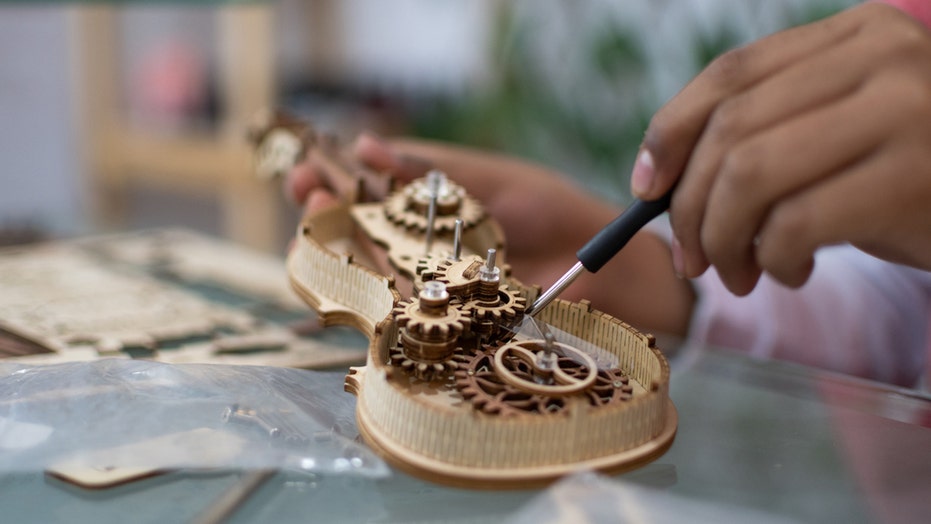
Wooden mechanical puzzles and miniature kits tap a similar market but with a different aesthetic. They sit at the intersection of craft, engineering and home décor: a steampunk “Book of Secrets,” a cello that doubles as a music box, or a tiny greenhouse that lights up. These are not toys in the traditional sense; they’re adult hobbies disguised as gifts and art.
What These Kits Are Really Selling: Focus, Control and Tangible Progress
Look at the language around these products: “meditative,” “focused fun,” “welcome break from scrolling,” “seven hours of hands-on fun.” This isn’t coincidental. These kits are being marketed as analog antidotes to digital overload.
Psychologists have been documenting a surge in anxiety, burnout and attention problems, especially since the pandemic. Time-use data shows adults spending upwards of 7–8 hours a day on screens, much of it fragmented across apps. The appeal of a 2,316-piece Van Gogh set or a 263-piece wooden puzzle is precisely the opposite: instead of endless, unstructured feeds, you get a clear goal, step-by-step instructions, and the satisfaction of completion.
This is why many experts liken these builds to structured mindfulness practices. You are forced into single-tasking: pick a piece, find its place, repeat. For people whose daily life feels chaotic, these sets offer a rare sense of control and linear progress.
There’s also a dignity to the final result. A Lego Statue of Liberty towering 17 inches, a tranquil Zen garden, or a fully furnished miniature tearoom isn’t just a pastime; it becomes a visible object in your home that says: “I built this. I can still make something real.” In a service-heavy, knowledge-based economy where many people never see a tangible outcome from their work, that matters.
Nostalgia Meets Design: How Childhood Play Became Adult Lifestyle
Another layer here is cultural signaling. A Lego wildflower bouquet is doing double duty: it’s playful, but it’s also minimalist, modern décor. A tiny greenhouse with LED lights isn’t just a toy; it’s lifestyle content waiting to be photographed and posted.
We’re watching childhood brands reposition themselves as design objects. The Lego Botanical series, for example, replaces real flowers, signaling taste and quirkiness while being maintenance-free and sustainable. A mechanical cello music box hints at cultural capital: music, craftsmanship, and a nod to analog aesthetics in a digital age.
Miniature kits like “Cathy’s Flower House” and DIY dollhouses tap into a long tradition of dollhouses as aspirational models of domestic life. Historically, dollhouses were actually adult objects – 17th- and 18th-century European “cabinet houses” were showcases of wealth and taste, not children’s toys. Today’s laser-cut, LED-lit miniatures are arguably a 21st-century revival of that tradition, just democratized and mass-produced.
The Mental Health Dimension: Beyond ‘Cute Hobbies’
There’s mounting research supporting what many builders already feel intuitively: these activities can function like informal therapy.
- Studies on crafting and hands-on hobbies (knitting, woodworking, model building) have linked them to lower levels of stress and improved mood, partly through creating “flow states” – deep, focused immersion in a task.
- Occupational therapists increasingly recommend puzzle-based and construction hobbies for adults dealing with anxiety, depression or post-burnout recovery, because they combine fine motor skills, planning and problem-solving.
- For older adults, model kits and puzzles are used to help maintain cognitive function and dexterity, functioning as a form of brain training.
What’s missing from most consumer coverage is a frank acknowledgment that many people are turning to these kits because conventional coping strategies aren’t working. If your job, news diet and social media feeds feel out of control, building a steampunk “Book of Secrets” with hidden compartments can be subtly therapeutic. You get to literally construct a world with rules you understand – and then open and close it at will.
Ownership, Identity and the Rise of the ‘Display Hobby’
Another underexplored trend is how these builds function as identity markers. Unlike traditional puzzles you disassemble and put back in the box, most of these kits are designed to be displayed. That’s not incidental; it’s a business model and a cultural shift.
Owning a Star Wars X-wing model you built from flat metal sheets, or a Zen garden assembled piece by piece, is akin to curating your own personal museum exhibit. It’s also a quieter, more controlled form of self-presentation than social media. Your shelves become your profile page.
Brands know this. They choose subjects tied to fandoms (Star Wars), art history (Van Gogh), travel and national icons (Statue of Liberty), and aspirational domesticity (tearooms, greenhouses). The kits not only give you a relaxing build; they give you a story to tell about who you are: a New Yorker at heart, an art lover, a sci-fi fan, someone who values calm and nature.
The Commerce Behind the Calm: Affiliate Links and Emotional Marketing
The original article is also a textbook example of how emotional needs are being harnessed to drive online sales. Almost every product is accompanied by affiliate links to major retailers, positioned as deals and holiday must-haves. The framing leans heavily on emotional benefits – “break from scrolling,” “meditative build,” “beautiful home decor” – more than on price competitiveness or technical specs.
This matters because it shows where the market is heading. We’re not just buying objects; we’re being sold potential states of mind: calm, focus, nostalgia, pride. The risk is that the marketing outpaces the actual benefits: no kit, however intricate, can fix structural burnout, job insecurity or systemic mental health gaps. There’s a fine line between genuinely helpful hobbies and what could become “self-care consumerism,” where every emotional need is met with a buy button.
What Happens Next: From Niche Hobby to Everyday Infrastructure?
Looking forward, several trajectories are worth watching:
- Gamification and hybrid kits: Expect more models that blend physical building with digital layers – augmented reality instructions, app-connected features, or sound and motion elements. The mechanical cello music box and Book of Secrets already hint at kinetic, interactive builds.
- Workplace integration: Some companies have begun introducing Lego or puzzle corners as informal stress-relief zones. If the science continues to support their benefits, you may see organized “build sessions” as part of wellness programs – or, less charitably, as cheap substitutes for substantive mental health support.
- Community and social building: Online forums and local building clubs are likely to grow. Multi-hour builds like the 7-hour miniature houses lend themselves to shared projects, livestreams and in-person meetups, shifting the activity from solitary to communal.
- Class and access questions: Many of these sets are not cheap – $60, $110, $120 per kit. If they become core tools of stress relief and creative expression, it raises equity questions: who can afford “therapeutic” hobbies marketed this way, and who gets left with free but less structured – and often more addictive – digital entertainment?
There’s also a climate angle lurking just offstage. These items are plastic- and wood-heavy, shipped worldwide for short-lived holiday seasons. Brands are beginning to tout sustainable materials and recyclable packaging, but if adult building continues to boom, its environmental footprint will become harder to ignore.
The Overlooked Story: Adults Quietly Rewriting What Play Looks Like
What mainstream coverage tends to miss is that this isn’t just about toys that “grown-ups secretly like.” It’s about adults renegotiating the terms of their own leisure in a culture that monetizes every spare second of attention.
These kits represent a compromise: they are still consumer products, often aggressively marketed, but they create pockets of time where the feedback loop is slower, physical and finite. They’re one of the few commonly accepted ways for adults to say, “I’m going to spend hours doing something seemingly ‘unproductive’ that makes me feel better,” without needing to justify it as exercise, professional development or parenting.
In that sense, the popularity of Lego Botanicals on coffee tables and miniature greenhouses on shelves isn’t just a seasonal gifting fad. It’s quiet evidence of a deeper hunger: for tactile experiences, for manageable challenges, and for a form of play that feels compatible with – and sometimes gently subversive of – adult life.
If the last decade was defined by the rise of infinite digital feeds, the next may be shaped, in part, by people deliberately choosing finite, physical builds instead. Whether that shift will be enough to seriously rebalance our relationship with technology is an open question. But as long as anxiety remains high and attention feels scarce, don’t expect these adult building kits to remain a niche corner of the holiday gift guide. They’re telling us something fundamental about what grown-ups are missing – and what they’re trying to build back, one tiny piece at a time.
Topics
Editor's Comments
What’s striking about this seemingly light holiday story is how much it reveals about the quiet compromises many adults are making with modern life. On one hand, these kits undeniably offer real psychological and creative benefits: they impose structure on scattered attention, reward patience in a culture that prizes speed, and give people a way to craft something physical in an increasingly intangible economy. On the other hand, their rise underscores how solutions to systemic problems—overwork, digital surveillance capitalism, threadbare public mental health systems—are being individualized and commodified. Instead of collectively reining in the forces that shred our attention, we’re invited to buy intricate workarounds. That doesn’t invalidate the joy or relief people find in building, but it does raise a harder question: how much of our coping is being outsourced to products, and what would it look like to design workplaces, technologies and social policies that made this kind of intensive self-soothing less necessary in the first place?
Like this article? Share it with your friends!
If you find this article interesting, feel free to share it with your friends!
Thank you for your support! Sharing is the greatest encouragement for us.